
 Search
Learning | Energy & Commodity Derivatives
How to Hedge Power Purchase Agreements
Introductory Summary
A renewable Power Purchase Agreement (PPA) can leave participants exposed to several interacting sources of market and volume risk. The most appropriate hedge depends on the structure of the PPA, the characteristics of the underlying renewable generation and the availability of suitable market instruments.
The objective is not necessarily to replicate the PPA exactly. It is to identify which exposures matter most, determine which can be hedged effectively and find a practical balance between risk reduction, liquidity and cost.
For a detailed explanation of how PPA structures and generation characteristics create these exposures, see the What is a Power Purchase Agreement (PPA)? article.
Start With the PPA Risk Profile
Before selecting a hedge, it is important to understand what the PPA is actually exposing the portfolio to.
A renewable PPA can contain price, volume, seasonal, intraday shape and basis exposures, with their relative importance depending on the contract structure and underlying generation profile.
The detailed valuation and simulation framework used to identify these exposures is covered in the How to Value and Assess Risk of Power Purchase Agreements (PPAs) article.
The key point for hedging is simple:
The hedge should be designed around the actual exposure, rather than simply matching the PPA’s headline volume.
Use the PPA Analysis to Test Hedge Strategies
Once the PPA has been valued and its risk distribution understood, the same underlying analysis can be used to assess potential hedges.
There is no need to rebuild the model for each strategy. Possible hedges can be applied to the same simulated scenarios and the resulting PPA-and-hedge distributions compared.
This allows participants to assess whether a proposed hedge genuinely improves the portfolio’s risk profile.
Baseload Flat Hedges
A baseload hedge provides a relatively simple way of managing broad power-price exposure. It can be particularly useful for longer-dated PPAs where more granular market products are less liquid or unavailable. Its main advantage is simplicity and, where available, liquidity.
However, a flat baseload hedge does not reproduce the full profile of a renewable PPA. Residual exposure can remain to:
- seasonal price differences;
- intraday price shape;
- renewable volume variability; and
- the difference between the PPA’s generation profile and the hedge profile.
The result can be a useful first layer of protection without being a complete hedge.
Seasonal Price Hedges
Seasonal hedges add further detail by allowing different periods of the year to be hedged separately.
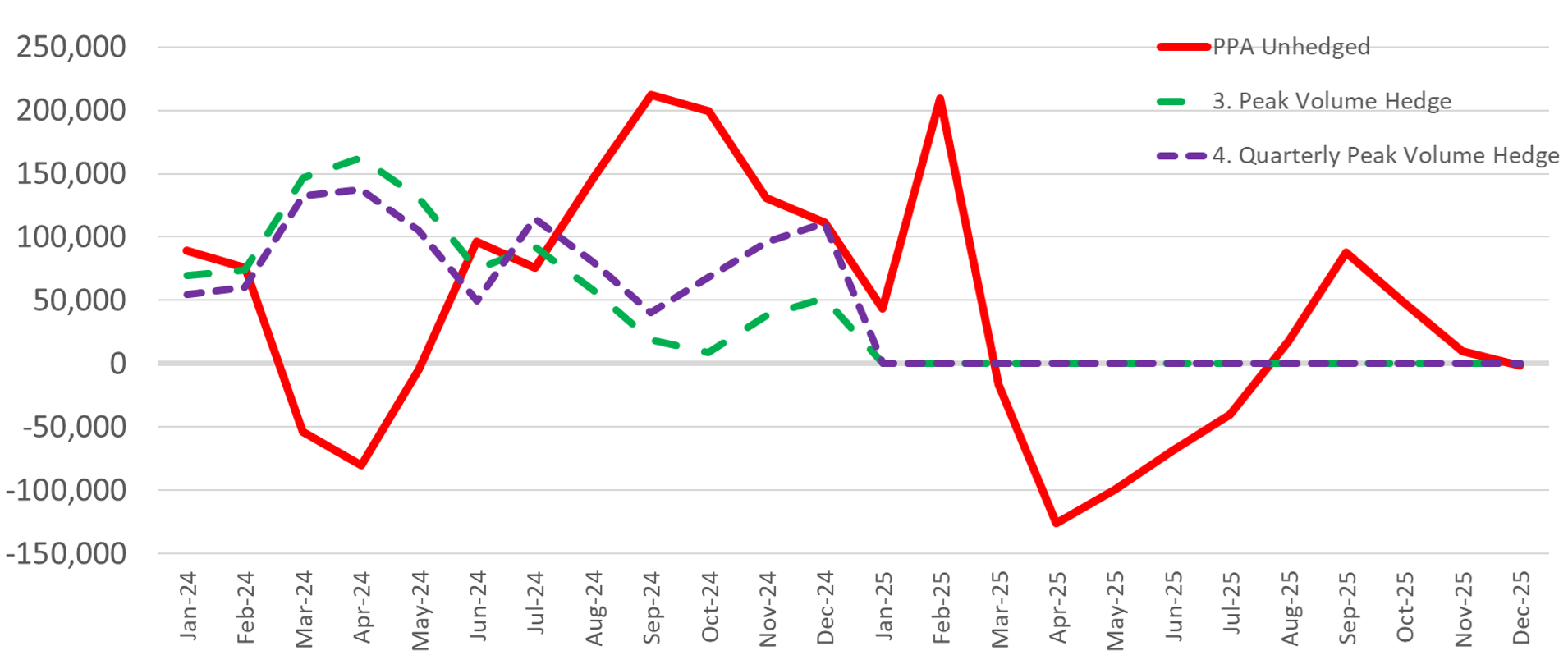
Quarterly or monthly products can provide a closer match to the seasonal characteristics of the PPA where sufficient market liquidity exists. This can reduce exposure left behind by a simple annual baseload hedge, although the availability and liquidity of more granular products will typically vary across the forward curve.
For long-dated PPAs, this can result in a practical distinction between the front of the curve, where more detailed products may be available, and the longer-dated periods, where simpler hedges may be more appropriate.
Peak and Off-Peak Hedges
Peak and off-peak products can introduce further intraday detail into the hedging strategy. This can be particularly useful when the timing of renewable production has a meaningful relationship with the shape of power prices.
Solar generation provides an obvious example. It has a relatively predictable broad intraday profile, with production concentrated during daylight hours. A peak-oriented hedge can provide a closer approximation to this exposure than an entirely flat hedge.
Wind generation generally has less deterministic intraday behaviour. The focus may therefore be more on managing the relationship between wind generation and the relevant power-price shape rather than matching every production hour.
Combine Seasonal and Intraday Hedging
For some PPAs, the most effective approach is to combine seasonal and intraday hedging. A seasonal peak/off-peak strategy can address both:
- differences in power prices across the year; and
- differences between peak and off-peak periods.
This can further reduce residual exposure after a simpler baseload or seasonal hedge. However, increased granularity brings practical trade-offs.
There may be less liquidity, greater pricing uncertainty and a larger mismatch between the desired hedge and the instruments that are actually available. A more detailed hedge is therefore not automatically a better hedge.
Test Hedge Effectiveness
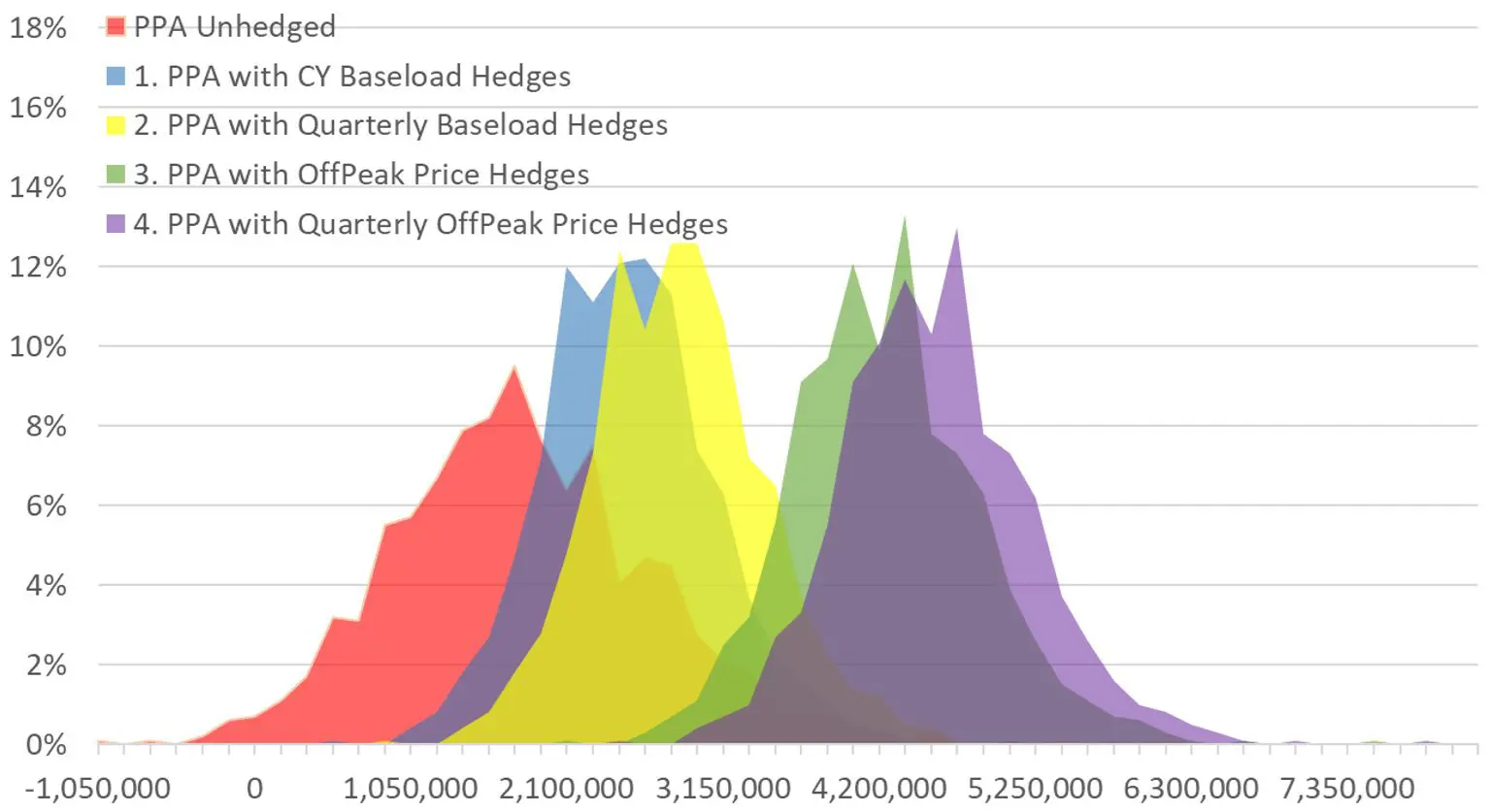
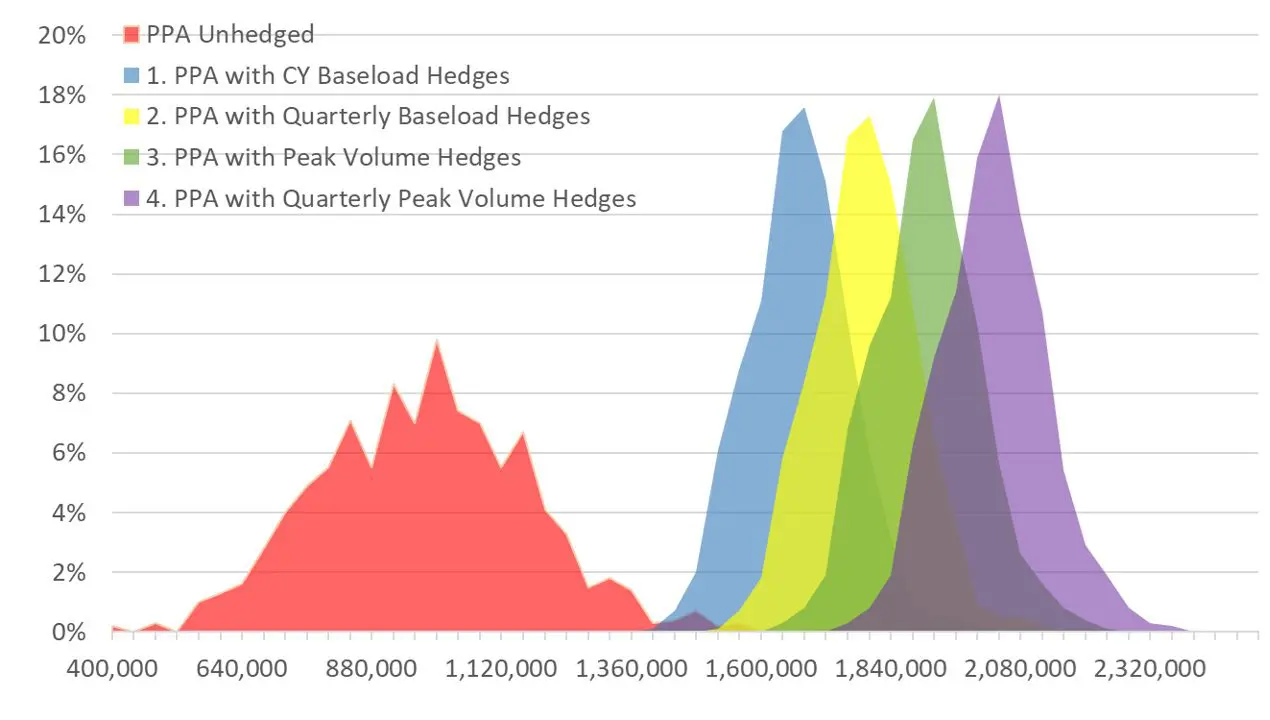
The effectiveness of a hedge should be measured using the same underlying assumptions and simulations used to analyse the PPA itself.
A hedge should not be judged solely by whether it increases the expected PPA value, but by whether the combined PPA and hedge portfolio has a better risk profile.
An effective hedge may:
- narrow the distribution of outcomes;
- reduce adverse tail outcomes;
- offset particular seasonal exposures; or
- improve cash-flow predictability.
Possible strategies can therefore be compared by running the unhedged PPA and alternative hedge structures through the same set of simulated scenarios. This provides a consistent basis for deciding how much risk the hedge removes and what exposure remains.
The Best Hedge Is Not Always the Most Detailed
There is a natural temptation to make a hedge increasingly granular in pursuit of a closer theoretical match. In practice, that may not be optimal. More detailed products can have:
- lower liquidity;
- higher transaction costs;
- greater basis risk;
- more difficult execution; or
- limited availability at longer maturities.
A simpler hedge may therefore provide a better overall result when its effectiveness is weighed against the practical constraints of the market. The objective should be to find the most effective practical hedge, rather than the most mathematically precise one.
Consider Optional Protection
For some PPA exposures, participants may also consider options where a simple linear hedge does not provide sufficient protection.
Caps, floors, collars and other option structures can provide more targeted protection against adverse price movements while retaining some exposure to favourable outcomes.
The trade-off is that this protection comes at a cost, and suitable long-dated products may not always be liquid enough to implement the desired hedge. Options should therefore be assessed alongside the simpler hedge strategies rather than treated as a universally superior solution.
Assess Hedges at a Portfolio Level
A PPA rarely exists in isolation. It may sit alongside other PPAs, renewable assets, forward contracts, futures, options or physical positions. The effectiveness of a hedge should therefore ultimately be assessed in the context of the wider portfolio.
A hedge that appears effective against one PPA could produce a very different result once other positions are included. This is why the analysis should consider the distribution of the combined portfolio, not just the distribution of an individual PPA.
Monitor and Refine the Hedge
A hedge is not necessarily a one-off decision. As the PPA progresses through its term, market prices change, the remaining generation profile becomes clearer and the liquidity of available hedge products evolves. The relative importance of different risk factors can therefore change over time.
Participants may need to reassess:
- the remaining PPA exposure;
- hedge volumes;
- seasonal positioning;
- intraday hedging;
- available market liquidity; and
- the risk profile of the wider portfolio.
This turns PPA hedging from a transaction-level exercise into an ongoing portfolio-management process.
Final Thoughts
There is no single hedge that is appropriate for every PPA. A baseload hedge may provide a practical starting point for longer-dated exposures, while seasonal, peak or off-peak products can be layered on where the underlying risk and market liquidity justify greater granularity.
The most important step is to start with a clear understanding of the PPA’s exposure and then test possible hedges against that exposure using a consistent valuation and risk framework.
The result should be a hedge that reduces the risks that matter most to the portfolio while remaining practical to execute, monitor and maintain.
One-Sentence Takeaway
Hedging a PPA involves identifying its most important price, volume, seasonal and shape exposures and selecting practical hedge strategies that reduce portfolio risk while balancing effectiveness, liquidity and cost.
Related Learning Resources
What is a Power Purchase Agreement (PPA)?
Understand how different PPA structures allocate price, volume and other risks between participants.
How to Value and Assess Risk of Power Purchase Agreements (PPAs)
Learn how to model power prices, renewable generation and their joint behaviour to value PPAs and understand their risk distributions.
Understand the market price representation that underpins many energy hedging decisions.
What is an Energy Trading and Risk Management (ETRM) System?
Understand what ETRM systems do, where their limitations lie, and why organisations complement them with specialist valuation and risk analytics.