
 Search
Learning | Foundations of Energy Risk
What is Credit Risk?
Introductory Summary
Every energy contract depends on more than market prices.
Whether buying electricity, selling natural gas, entering into a derivatives transaction, or transporting commodities through a pipeline, each agreement assumes that both parties will honour their contractual obligations.
Credit risk arises when that assumption no longer holds.
In energy and commodity markets, participants often maintain hundreds or even thousands of contractual relationships simultaneously. Understanding the financial strength of counterparties, monitoring exposures as market conditions evolve, and managing the potential consequences of default are therefore fundamental components of enterprise risk management.
Definition
Credit risk is the risk that a counterparty fails to meet its contractual obligations, causing financial loss to another party.
These obligations may include:
- payment for delivered commodities;
- physical delivery of contracted volumes;
- settlement of derivative contracts;
- collateral obligations; or
- other contractual commitments.
In energy markets, credit risk exists across both physical and financial transactions and can change continuously as market prices and contract values evolve.
Why Credit Risk Matters
Unlike market risk, which arises from changes in prices, credit risk depends on the financial condition and behaviour of counterparties. Even a profitable contract can create losses if the counterparty becomes unable or unwilling to perform.
For example:
- an energy retailer may fail before paying for electricity already delivered;
- a commodity trader may default on a profitable derivatives position;
- an LNG buyer may be unable to fulfil long-term contractual commitments; or
- a generator may lose expected revenues because an offtaker enters administration.
These events can create direct financial losses while also disrupting commercial operations and requiring replacement transactions under less favourable market conditions.
Credit Risk Versus Market Risk
Although both are fundamental components of risk management, market risk and credit risk arise from different sources.
Market risk reflects uncertainty in prices, volatility, interest rates, exchange rates, and other market variables. Credit risk reflects uncertainty about whether contractual obligations will be fulfilled.
The two risks often interact.
For example, rising electricity prices may significantly increase the value of a forward contract. While this creates a larger unrealised gain, it also increases the financial exposure to the counterparty responsible for paying that gain at settlement.
As market values change, credit exposures often change with them.
Sources of Credit Exposure
Credit exposure can arise from many different activities within energy and commodity markets.
Common examples include:
- physical commodity sales;
- over-the-counter derivative contracts;
- transportation agreements;
- tolling agreements;
- long-term LNG contracts; and
- collateral agreements.
Exposure is often dynamic rather than static, increasing or decreasing as market prices change throughout the life of a contract.
Measuring Credit Exposure
Managing credit risk requires more than identifying counterparties. Participants also need to understand how much exposure exists and how that exposure may evolve over time.
Measurements commonly consider:
- current replacement cost;
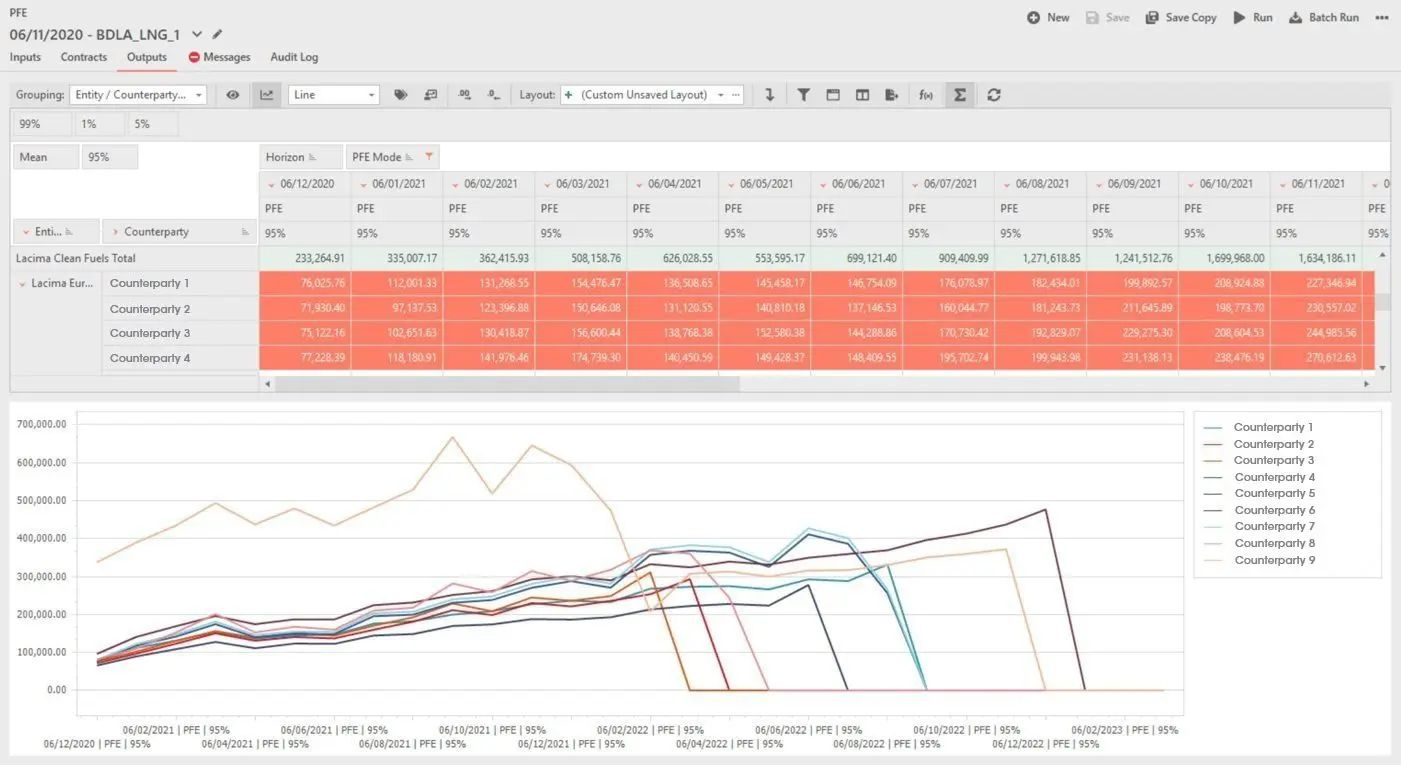
- potential future exposure;
- collateral held;
- contractual netting arrangements;
- credit limits; and
- liquidity risk.
Rather than relying solely on today’s exposure, organisations frequently assess how future market movements could increase potential losses under adverse conditions.
Managing Credit Risk
Energy organisations typically manage credit risk through a combination of commercial, legal, and analytical controls.
These may include:
- establishing counterparty credit limits;
- monitoring exposures continuously;
- requiring collateral or margin;
- using legally enforceable netting agreements;
- diversifying counterparties;
- performing regular credit reviews; and
- incorporating potential future exposure into commercial decision-making.
The objective is not to eliminate credit risk entirely, but to ensure that counterparty exposures remain consistent with an organisation’s overall risk appetite.
Why Credit Analytics Matter
Managing credit risk becomes progressively more challenging as organisations expand across counterparties, commodities, markets, and regions.
Exposures can change continuously as market prices move, contracts mature, collateral positions evolve, and new transactions are executed. Maintaining an accurate view of enterprise-wide credit exposure therefore requires organisations to combine market data, contractual information, collateral positions, and counterparty relationships into a consistent analytical framework.
Many organisations therefore choose integrated analytics platforms to:
- aggregate exposures across counterparties and portfolios;
- monitor credit limit utilisation;
- estimate potential future exposure;
- evaluate the impact of changing market conditions;
- analyse concentration risk; and
- support enterprise-wide reporting and governance.
For example, Lacima Analytics’ Credit Risk modules help organisations strengthen operational governance by centralising market data, automating workflows, maintaining audit trails, and providing consistent counterparty credit exposure analytics across the enterprise.
By replacing disconnected spreadsheets and manual processes with an integrated credit risk analytics platform, organisations can improve transparency, strengthen governance, reduce operational risk, and increase confidence in the information used to support commercial and risk management decisions.
Common Pitfalls and Misconceptions
Credit Risk Only Exists When a Counterparty Defaults
Losses usually begin accumulating well before an actual default occurs. Changes in credit quality, market values, or collateral positions can materially alter an organisation’s exposure.
Credit Risk Only Applies to Financial Contracts
Physical commodity contracts also create significant credit exposure whenever one party depends on another to perform future contractual obligations.
Good Counterparties Do Not Create Credit Risk
Even financially strong organisations can experience unexpected financial distress. Effective credit risk management therefore relies upon continuous monitoring rather than assumptions about long-term financial strength.
One-Sentence Takeaway
Credit risk is the risk that a counterparty fails to meet its contractual obligations, making effective exposure measurement and counterparty management essential components of energy risk management.
Related Learning Resources
What is Energy Risk Management?
Learn how organisations identify, measure, and manage market, credit, and operational risks across physical and financial energy portfolios.
Understand how changing market prices create financial exposure across energy and commodity portfolios.
Learn how market positions combine to create exposure across physical assets and financial contracts.
Understand how organisations assess portfolio resilience under severe but plausible market and counterparty events.