
 Search
Learning | Energy & Commodity Derivatives
What is Vega?
Introductory Summary
Volatility plays a central role in the valuation of energy and commodity options.
Even if commodity prices remain unchanged, the value of an option can increase or decrease as market expectations of future price volatility change.
Vega is the Greek that measures this relationship.
It estimates how much an option’s value is expected to change when expected market volatility changes, making it one of the most important risk measures used in option valuation.
In energy and commodity markets, Vega helps practitioners understand volatility exposure, evaluate pricing risk, monitor option portfolios, and support the valuation of contracts and assets containing optionality.
Definition
Vega measures the sensitivity of an option’s value to changes in expected market volatility.
More specifically, it estimates how much the value of an option is expected to change for a small change in implied or assumed volatility, assuming all other factors remain unchanged.
For example, if an option has a Vega of 0.40, a one percentage point increase in expected volatility would be expected to increase the option’s value by approximately 0.40 units.
Vega therefore measures volatility sensitivity, rather than price sensitivity or value itself.
Why Vega Matters
The value of many energy contracts depends not only on where prices are expected to move, but also on how uncertain those future prices are expected to be.
Vega provides that information, supporting activities such as:
- measuring volatility exposure;
- valuing option portfolios;
- monitoring changes in market uncertainty;
- supporting volatility hedging strategies;
- analysing contracts containing significant optionality;
- managing structured energy portfolios; and
- understanding the impact of changing market conditions.
Because Vega measures how option values respond to changing volatility assumptions, it is one of the fundamental building blocks of option risk management.
Why Volatility Matters
Unlike a forward contract, an option benefits from uncertainty.
The greater the range of possible future price outcomes, the greater the opportunity for an option to finish favourably.
For this reason, increases in expected volatility often increase the value of options, even when the expected future commodity price remains unchanged.
Conversely, if expected volatility falls, the potential benefit provided by the option is reduced, which often decreases its value.
Vega is the measure used to quantify this relationship.
What Determines Vega?
Although Vega is calculated mathematically within option pricing models, several factors influence its value:
Expected Market Volatility
Vega measures how sensitive an option is to changes in expected future volatility. The higher the uncertainty surrounding future prices, the greater the potential impact on option value.
Position Relative to the Strike Price
Options close to the strike price generally exhibit the greatest Vega because changes in volatility have the largest impact on the probability of finishing in-the-money.
Time Remaining
Options with longer periods until expiry often have higher Vega because there is more time for future market uncertainty to influence outcomes. As expiry approaches, Vega typically declines.
Vega Across Different Energy Assets
Vega is not limited to exchange-traded commodity options.
Many physical energy assets contain embedded optionality whose value depends upon future market uncertainty.
Examples include:
- swing contracts;
- transportation capacity; and
- virtual power plant optimisation.
As uncertainty surrounding future market prices changes, the value of these assets may also change, making Vega an important analytical measure.
Vega and Risk Management
One of Vega’s most important applications is understanding exposure to changing market uncertainty.
A portfolio with positive Vega generally benefits from increases in expected volatility because option values increase. Conversely, portfolios with negative Vega may lose value when volatility rises.
Unlike Delta, which responds primarily to movements in commodity prices, Vega responds to changes in market expectations regarding future price variability.
In practice, expected volatility changes continually as new information becomes available. Practitioners therefore monitor Vega alongside the other Greeks to understand how changing market conditions affect portfolio value.
Vega Is Only One of the Greeks
Although Vega measures sensitivity to changing volatility, it represents only one dimension of option risk.
Other Greeks describe how option values respond to changes in underlying prices, changing sensitivities, time, or interest rates.
For example:
- Delta measures sensitivity to changes in the underlying commodity price.
- Gamma measures how rapidly Delta changes as prices move.
- Theta measures the effect of time decay.
- Rho measures sensitivity to interest rates.
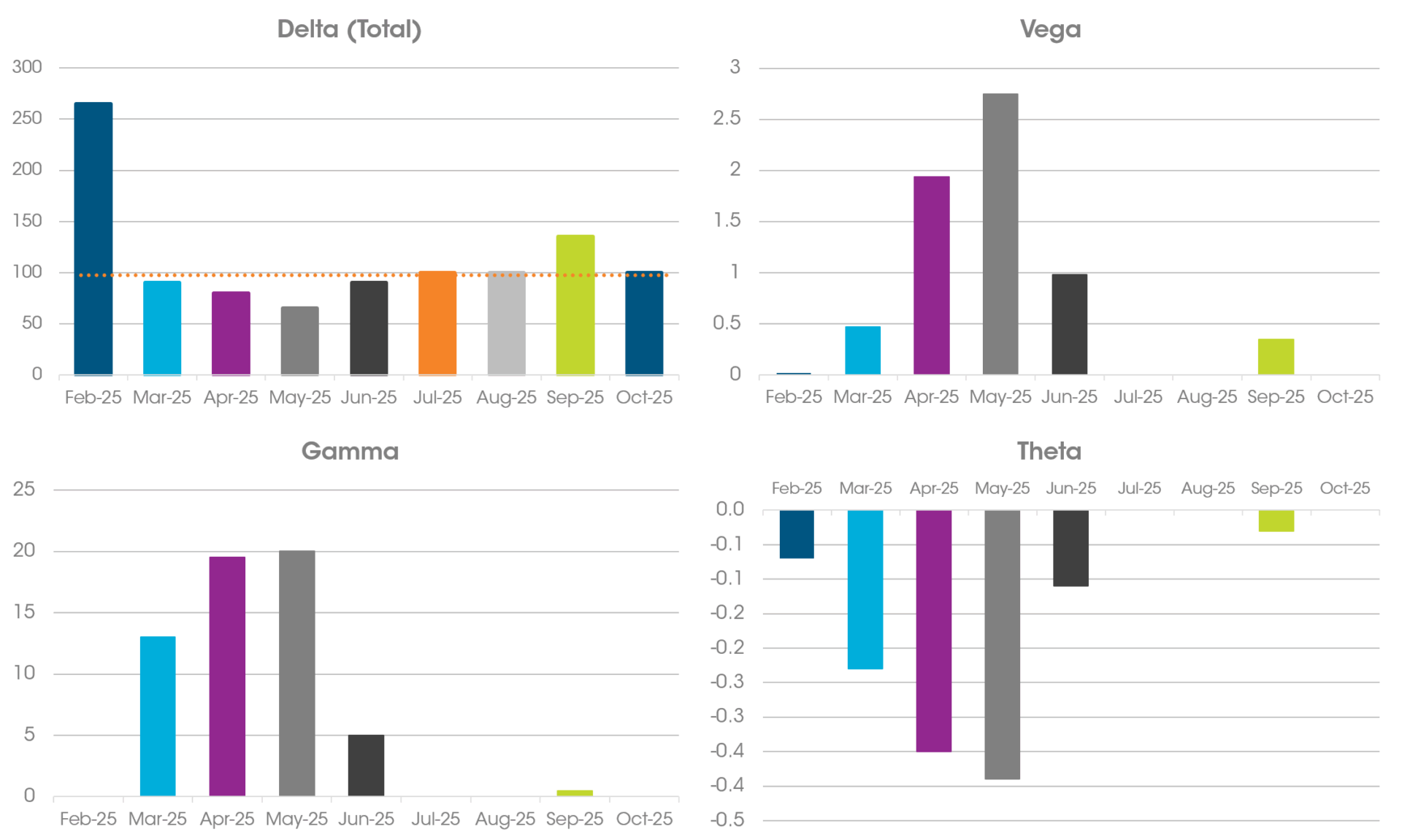
Together, these measures provide a more complete picture of option risk.
Common Pitfalls and Misconceptions
Vega Predicts Future Volatility
Vega does not predict whether volatility will increase or decrease. It simply measures how sensitive an option’s value is if volatility changes.
Vega Never Changes
Vega is dynamic. As commodity prices, expected volatility, and time to expiry evolve, Vega also changes. This is one reason why option portfolios require continual monitoring.
Vega Only Matters for Financial Options
Many physical energy assets contain embedded optionality whose value depends upon market uncertainty. Understanding Vega therefore becomes important across a much broader range of energy valuation problems than exchange-traded options alone.
Managing Vega in Practice
Monitoring Vega across large portfolios manually becomes increasingly difficult as portfolios grow in size and complexity.
Every change in expected market volatility affects the value of options and physically flexible assets. As a result, volatility sensitivities evolve continuously alongside changing market conditions.
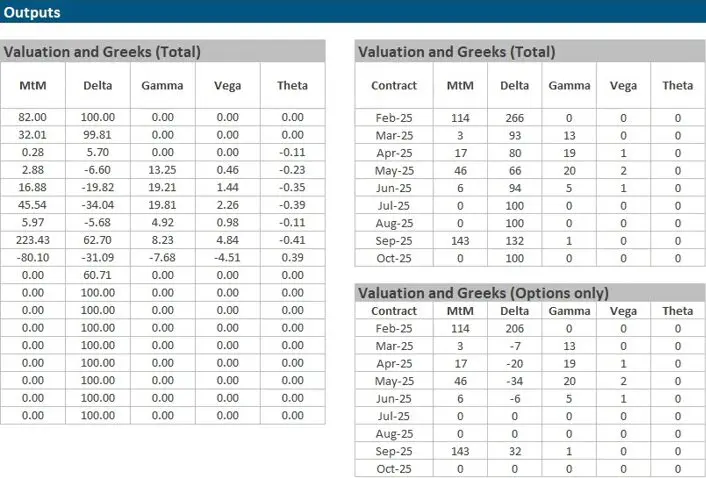
Applications such as Lacima Trader enable analysts and traders to perform Greeks calculations and other energy valuation and risk analytics efficiently using common market data, forward curves, volatility assumptions, and valuation models. At enterprise scale, Lacima Analytics extends these capabilities by helping organisations maintain consistent analytical assumptions, improve transparency, and support robust reporting and governance across trading, risk, finance, and commercial functions.
One-Sentence Takeaway
Vega measures how sensitive an option or flexible asset is to changes in expected market volatility, making it one of the key tools for understanding, valuing, and managing option risk in energy and commodity markets.
Related Learning Resources
Learn how Delta measures an option’s sensitivity to changes in the underlying commodity price.
Understand how Gamma measures the rate at which Delta changes as market prices move.
Explore how the passage of time influences the value of energy and commodity options.
What is a Volatility Function?
Learn how volatility functions represent changing volatility across time and maturity and why this matters for option valuation and Vega sensitivity.