
 Search
Learning | Valuation & Pricing Analytics
What is Intrinsic Value?
Introductory Summary
Intrinsic value represents the value that could be realised immediately if a contract, option, or operational decision were exercised using current market conditions.
In energy and commodity markets, intrinsic value provides a useful starting point for understanding what an asset or contract is worth today. However, many energy contracts contain flexibility that extends beyond today’s market prices, meaning intrinsic value often tells only part of the story.
Understanding intrinsic value is therefore an important foundation for analysing optionality and more sophisticated valuation approaches.
Definition
Intrinsic value is the immediate economic value of a contract or asset based solely on current observable market conditions.
It answers a simple question:
“If this decision had to be made today, what would it be worth?”
Intrinsic value ignores uncertainty about future market movements and assumes decisions are based entirely on information currently available.
Why Intrinsic Value Matters
Intrinsic value provides a simple and intuitive benchmark. Participants frequently use it to:
- understand whether a position currently has economic value;
- compare opportunities across a portfolio;
- establish a baseline for more advanced valuation techniques; and
- distinguish between immediate value and potential future value.
Although intrinsic value provides a useful benchmark, it often represents only the starting point for valuing energy contracts and assets with embedded flexibility. In practice, participants frequently compare intrinsic valuations with approaches that account for uncertainty and future decision-making to understand the full economic potential of a position.
A Practical Energy Example
Consider a gas-fired generator. If today’s electricity prices exceed the combined costs of fuel and operations, the generator may have positive intrinsic value because operating the asset immediately would generate an economic benefit.
Similarly, an option contract may possess intrinsic value if exercising the option today would be advantageous based on current prices.
If exercising the contract would not currently be beneficial, its intrinsic value is generally zero.
Intrinsic Value Versus Future Opportunity
One of the limitations of intrinsic value is that it assumes market conditions are fixed.
In reality, energy markets are characterised by uncertainty, volatility, and operational flexibility.
Participants often face choices that can be deferred until additional information becomes available. The ability to wait and respond to future conditions can itself create value.
This means that contracts with little or no intrinsic value today may still possess significant economic worth.
Common Misunderstandings
Intrinsic Value Represents the Full Value of a Contract
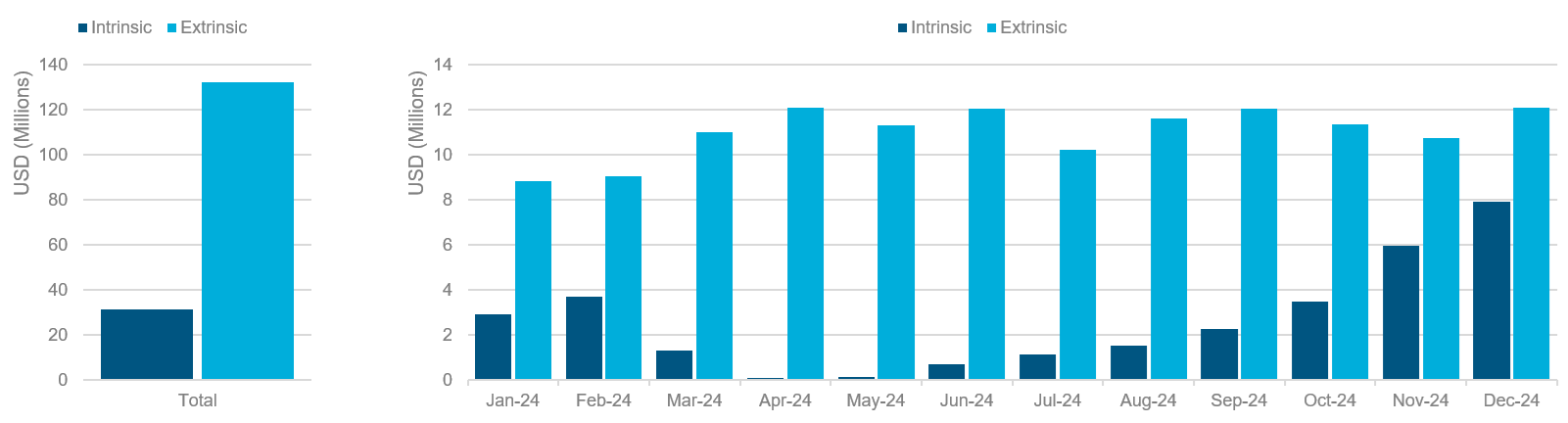
Intrinsic value captures only what could be realised immediately. Many energy contracts and physical assets derive additional value from future flexibility, optionality, and changing market conditions. In many cases, the extrinsic value of a contract can far exceed its intrinsic value.
Zero Intrinsic Value Means Something Has No Value
A contract that has no immediate economic benefit may still become valuable in the future. This is particularly relevant for options, storage assets, swing contracts, and other structures where decisions can be delayed.
Intrinsic Value Requires Complex Models
One of the reasons intrinsic value remains widely used is its simplicity. Because it relies on current market information rather than simulations of future outcomes, it can often be estimated using straightforward analytical approaches.
Intrinsic Value in Professional Practice
Intrinsic value is rarely viewed in isolation. Participants commonly compare intrinsic valuations with more sophisticated approaches that incorporate future uncertainty and optionality.
Doing so provides insight into how much value arises from immediate economics versus the flexibility to adapt future decisions.
Integrated valuation frameworks help ensure these perspectives are assessed consistently across increasingly complex portfolios. Tools like Lacima Analytics can help assess intrinsic value alongside broader valuation and risk considerations.
One-Sentence Takeaway
Intrinsic value measures what a contract or asset is worth based on today’s market conditions, providing an important foundation for understanding the broader value of flexibility in energy markets.
Related Learning Resources
Learn how future uncertainty and flexibility can create value beyond immediate economics.
What is Monte Carlo simulation?
Explore one of the approaches used to evaluate uncertain future outcomes.
Discover why flexibility within energy contracts can have substantial economic value.
Understand how operational choices contribute to the value of physical energy assets.