
 Search
Learning | Energy & Commodity Derivatives
What is Delta?
Introductory Summary
Understanding how sensitive an option is to movements in the underlying market is fundamental to valuation, hedging, and risk management.
Delta is the measure that describes this relationship.
It estimates how much an option’s value is expected to change for a small change in the price of the underlying commodity, making it one of the most widely used option risk measures, or Greeks.
In energy and commodity markets, Delta is used to understand price exposure, construct hedging strategies, monitor portfolio sensitivities, and support the valuation of contracts and assets containing optionality.
Definition
Delta measures the sensitivity of an option’s value to changes in the price of the underlying commodity.
More specifically, it estimates how much the value of an option is expected to change for a small movement in the underlying market price, assuming all other factors remain unchanged.
For example, if an option has a Delta of 0.60, an increase of $1 in the underlying commodity price would be expected to increase the option’s value by approximately $0.60.
Delta therefore measures price sensitivity, rather than value itself.
Why Delta Matters
Understanding the value of an option is only part of effective risk management. Practitioners also need to understand how that value will respond as market prices move.
Delta provides that information, which supports activities such as:
- measuring market price sensitivity;
- constructing hedge positions;
- monitoring portfolio exposure;
- managing option portfolios;
- understanding changing risk profiles;
- supporting dynamic hedging strategies; and
- analysing the behaviour of flexible energy assets.
Because Delta measures how value changes as prices move, it forms one of the fundamental building blocks of option risk management.
Why Forward Contracts and Options Behave Differently
One of the key differences between forward contracts and options is how their values respond to changes in the underlying market.
A forward contract typically changes in value almost one-for-one with movements in the underlying commodity price. An option behaves differently.
Because an option provides a right rather than an obligation, its sensitivity depends on where the market sits relative to the option’s strike price.
When an option is far out-of-the-money, its value may change very little as market prices move. As the market approaches the strike price, however, the option’s value typically becomes much more sensitive to changes in the underlying commodity price.
Once an option moves deeply into-the-money, its behaviour increasingly resembles that of the underlying commodity itself.
This changing relationship is one of the defining characteristics of option valuation, and Delta is the measure used to quantify it.
What Determines Delta?
Although Delta is calculated mathematically within option pricing models, several factors influence its value:
Position Relative to the Strike Price
An option’s Delta depends heavily on whether it is:
- in-the-money;
- at-the-money; or
- out-of-the-money.
Options close to the strike price often experience the greatest changes in Delta.
Time Remaining
As expiry approaches, Delta can change rapidly, particularly for options near the strike price. This changing behaviour is one reason why option portfolios require continual monitoring.
Market Volatility
Changes in expected future volatility influence option values and therefore affect Delta. Higher uncertainty often changes the probability that an option will finish in-the-money, altering its sensitivity to price movements.
Delta Across Different Energy Assets
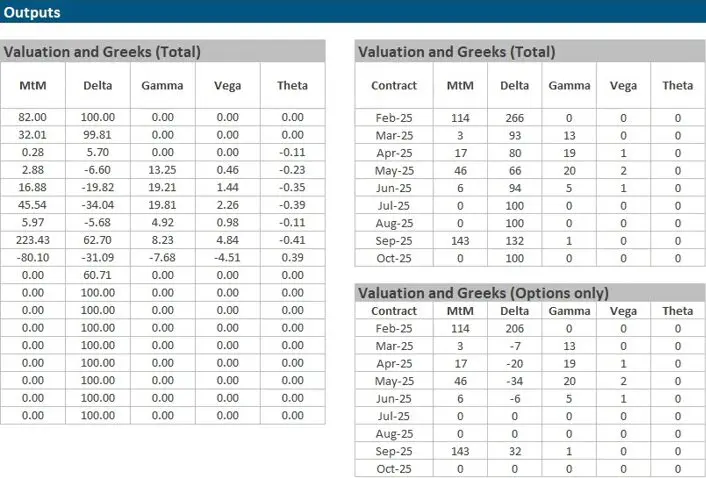
Delta is not limited to exchange-traded options. Many physical energy assets contain embedded optionality and therefore exhibit Delta exposure.
Examples include:
- swing contracts;
- transportation capacity and capacity rights; and
- virtual power plant optimisation.
Although these assets may not be described as ‘options’ in a commercial sense, their value often changes as commodity prices move, meaning Delta becomes an important analytical measure.
Delta and Hedging
One of Delta’s most important applications is hedging.
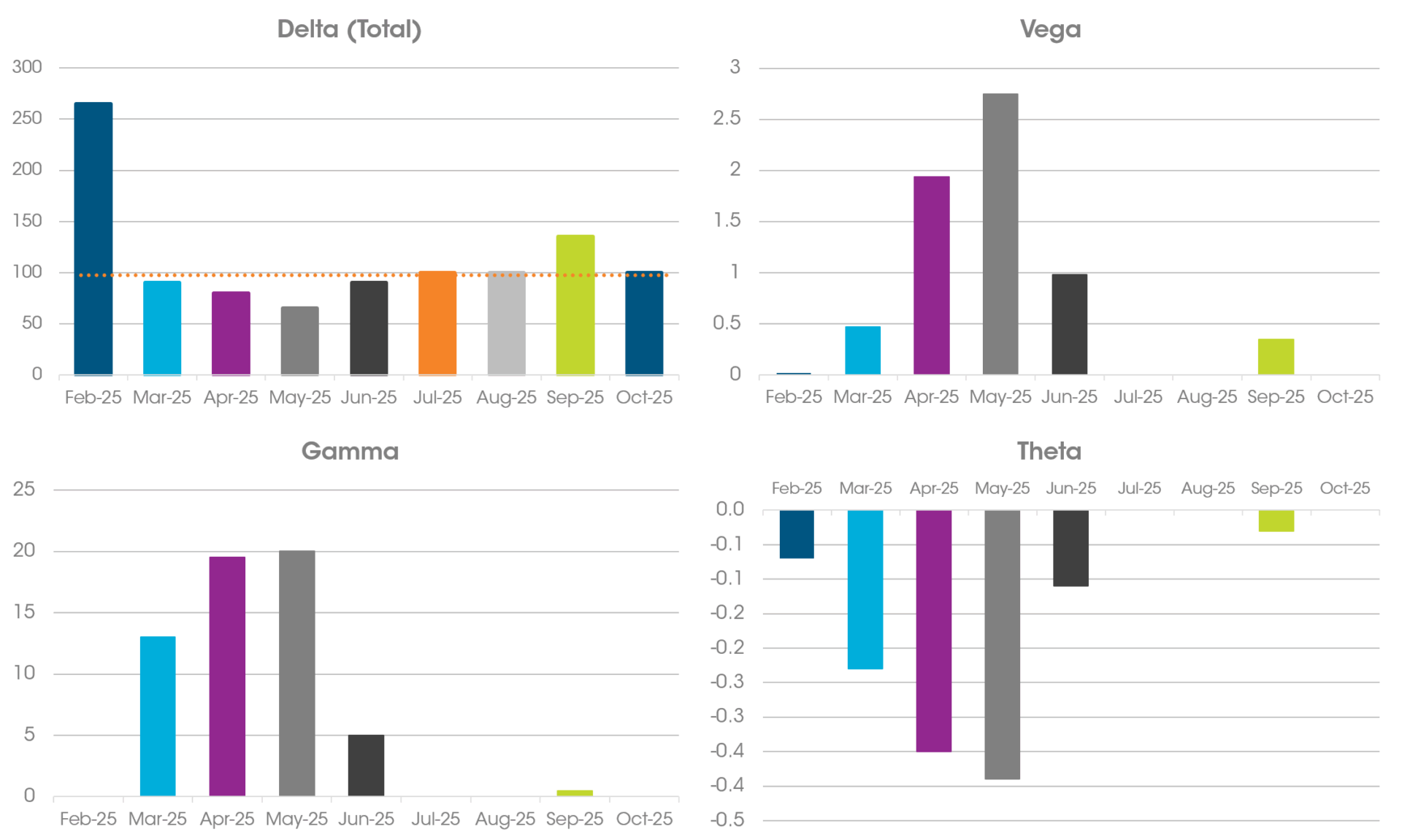
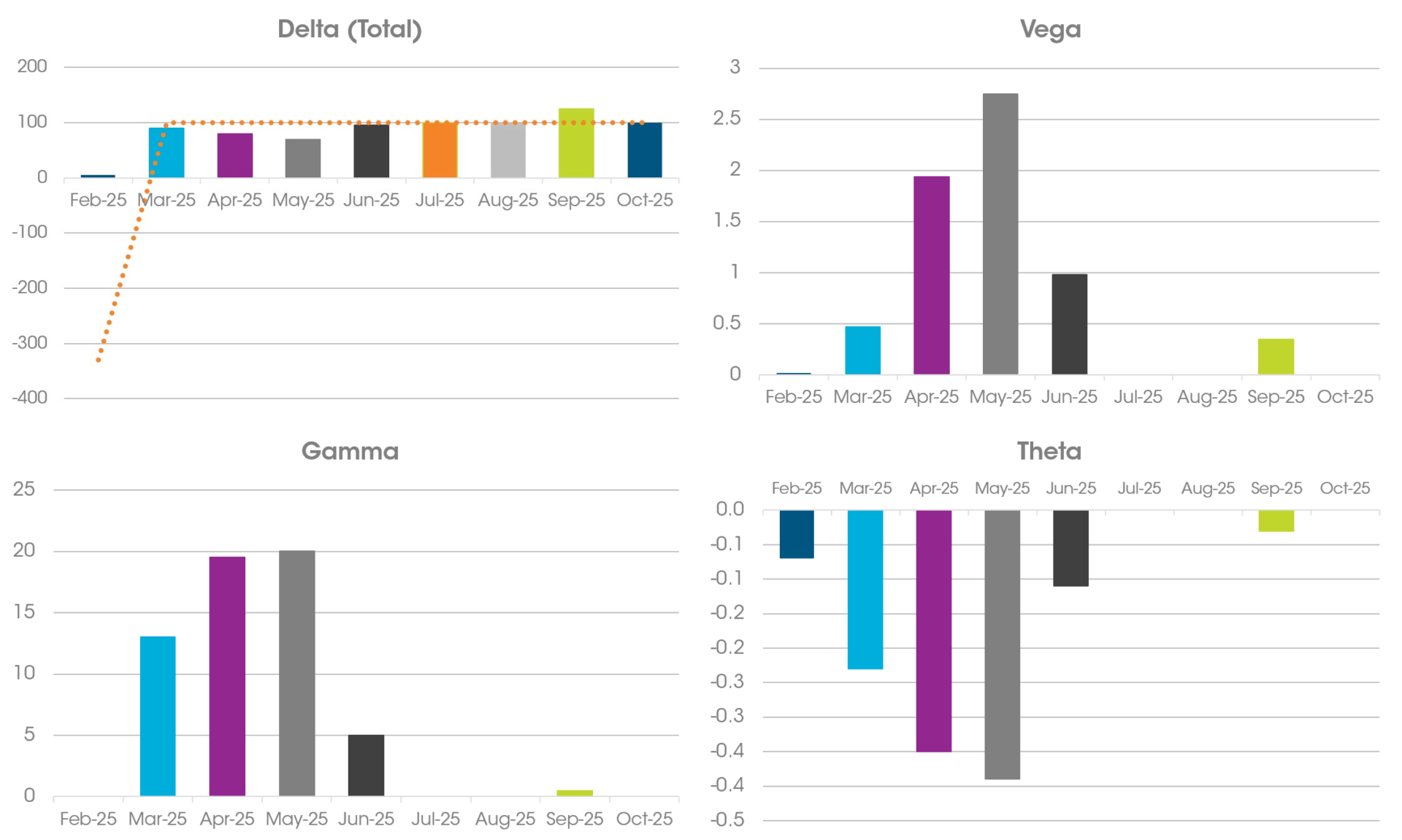
A portfolio with positive Delta benefits from rising prices but loses value when prices fall. Conversely, a portfolio with negative Delta behaves in the opposite manner.
By combining positions with offsetting Deltas, practitioners can reduce exposure to small market movements.
In practice, Delta is not static. As commodity prices, volatility, and time change, Delta changes as well. Maintaining an effective hedge therefore requires positions to be monitored and adjusted over time, a process commonly referred to as dynamic delta hedging.
Delta Is Only One of the Greeks
Although Delta is often introduced first, it represents only one dimension of option risk. Other Greeks describe how Delta itself changes, or how option values respond to changes in volatility, time, or interest rates.
For example:
Together, these measures provide a more complete picture of option risk.
Common Pitfalls and Misconceptions
Delta Predicts Future Prices
Delta does not predict where commodity prices will move. It simply estimates how an option’s value is expected to respond if prices move.
Delta Never Changes
Delta is dynamic. As market prices, volatility, and time evolve, Delta evolves as well. Understanding this changing behaviour is one reason why other Greeks, particularly Gamma, are also monitored.
Delta Eliminates Risk
Delta hedging reduces exposure to small market movements. It does not eliminate all risk. Large market movements, changing volatility, operational constraints, and evolving market conditions can all affect portfolio performance.
Managing Delta in Practice
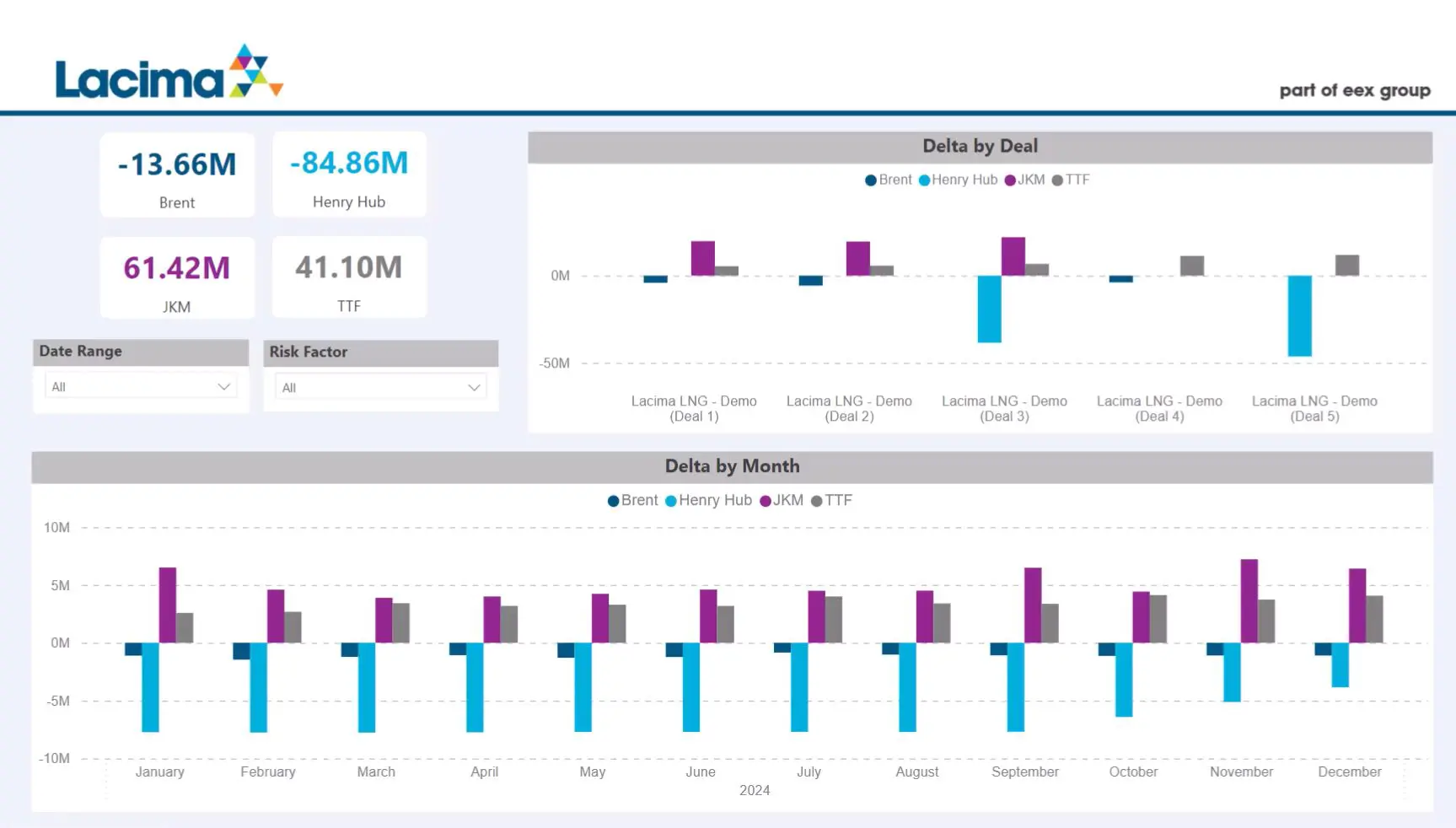
As portfolios become larger and more complex, monitoring Delta manually becomes increasingly difficult.
Every movement in commodity prices changes the Delta of options and physically flexible assets. As a result, portfolio sensitivities evolve continuously throughout the trading day.
Modern analytics platforms automatically recalculate Delta as market conditions change, allowing traders and risk managers to monitor evolving price sensitivities, evaluate hedge effectiveness, and identify emerging exposures before they become material.
Applications such as Lacima Analytics and Lacima Trader integrate option valuation, portfolio sensitivities, forward curves, optimisation models, and enterprise reporting within a controlled analytics environment, enabling organisations to manage Delta consistently across complex energy and commodity portfolios.
One-Sentence Takeaway
Delta measures how sensitive an option or flexible asset is to changes in the underlying commodity price, making it one of the most important tools for understanding, hedging, and managing option risk in energy and commodity markets.
Related Learning Resources
Learn how Gamma measures the rate at which Delta changes as market prices move.
Understand how changes in market volatility influence option values.
Explore how the passage of time affects option values.
Discover how changes in interest rates influence option valuation.