
 Search
Learning | Foundations of Energy Risk
What is Operational Risk?
Introductory Summary
Not every loss in energy markets is caused by changing prices or counterparty defaults. Many arise because something simply goes wrong.
A market data feed fails to update. A forward curve is built using incorrect assumptions. A trade is entered incorrectly. A generator experiences an unexpected outage. A gas shipment is scheduled incorrectly. A system interface fails overnight. A report is generated using incomplete data.
These events are examples of operational risk.
As organisations become increasingly dependent on complex commercial processes, physical operations, and integrated analytics, operational risk has become an essential component of enterprise risk management alongside market risk and credit risk.
Definition
Operational risk is the risk of financial loss or other adverse outcomes arising from failures in people, processes, systems, physical operations, or external events that disrupt the effective operation of an organisation.
Unlike market risk or credit risk, operational risk does not arise because market prices change or counterparties fail to perform.
Instead, it arises when the organisation itself, or the environment in which it operates, fails to support reliable business operations.
In energy and commodity markets, operational risk can affect trading, scheduling, dispatch, logistics, valuation, settlements, reporting, regulatory compliance, asset performance, and commercial decision-making.
Why Operational Risk Matters
Operational decisions are made continuously across energy organisations. Traders execute transactions, schedulers nominate deliveries, generators dispatch plant, storage operators inject and withdraw inventory, shipping teams optimise cargo movements, and risk managers monitor exposures.
Each of these activities depends upon accurate information, reliable systems, robust processes, and effective governance.
Failures anywhere along this chain can lead to financial losses, regulatory breaches, operational disruption, environmental incidents, reputational damage, or reduced confidence in commercial decision-making.
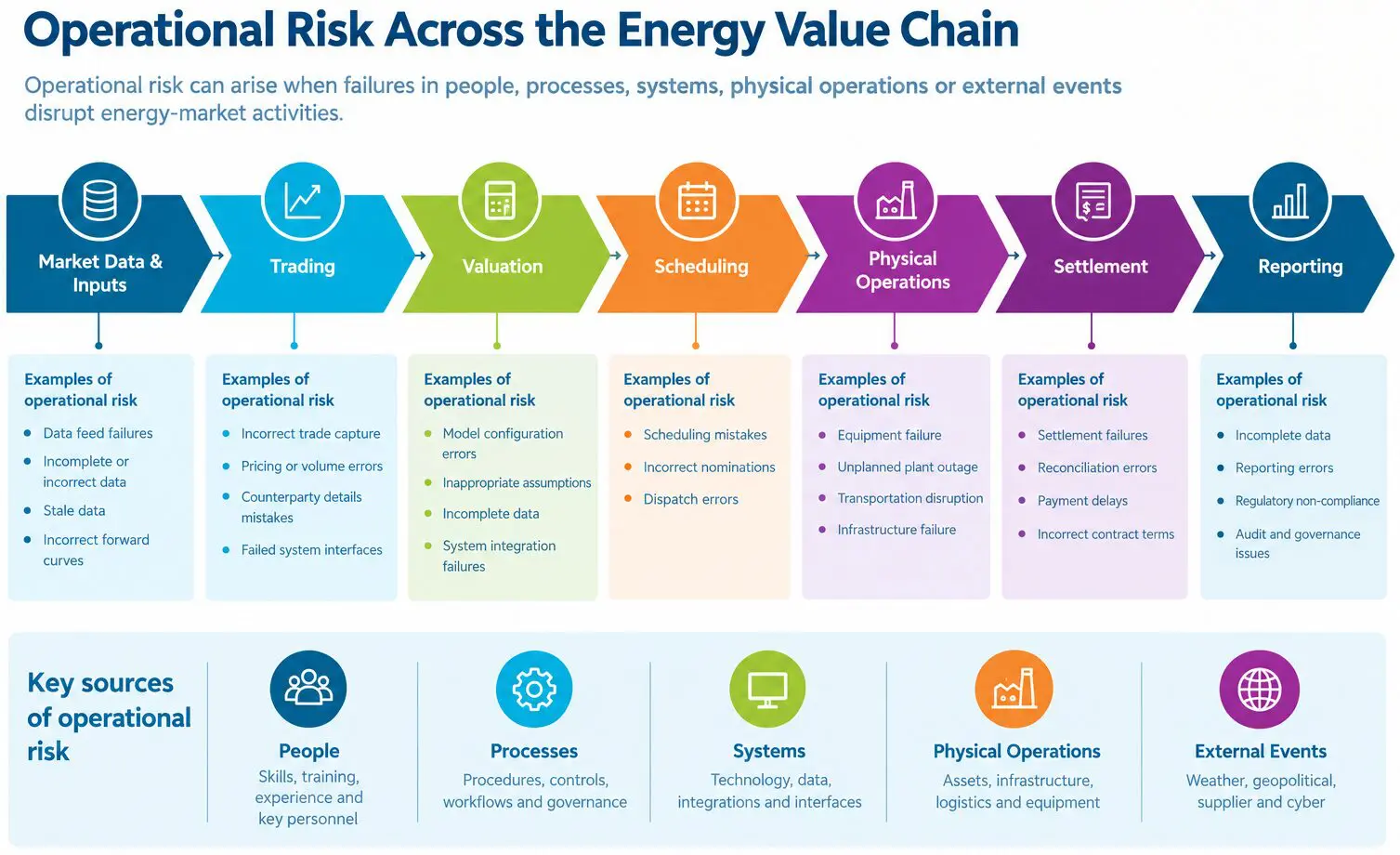
Common Sources of Operational Risk
Operational risk can arise throughout the lifecycle of an energy transaction. Examples include:
- incorrect trade capture;
- poor-quality market data;
- failed system interfaces;
- spreadsheet errors;
- valuation model configuration errors;
- incorrect forward curves;
- scheduling mistakes;
- dispatch errors;
- equipment failures;
- unplanned plant outages;
- transportation disruptions;
- settlement failures;
- inadequate approval processes;
- insufficient segregation of duties;
- cyber incidents;
- supplier failures; and
- natural disasters affecting business operations.
Although each event may appear isolated, collectively they can materially affect an organisation’s financial performance, operational reliability, and risk profile.
Operational Risk in Energy Analytics
Operational risk is particularly important in organisations that rely on quantitative analytics to support commercial and operational decisions.
Valuation, optimisation, and risk systems frequently depend upon large volumes of market data, complex mathematical models, and automated calculation processes.
For example, incorrect forward curves, inappropriate model assumptions, incomplete market data, or failed system integrations can all produce misleading valuations, poor dispatch decisions, incorrect shipping schedules, or inaccurate risk measures.
Even when the underlying analytical methodologies are robust, weaknesses in operational processes can undermine confidence in the decisions they support.
Managing Operational Risk
Managing operational risk involves reducing both the likelihood and the impact of operational failures. Common approaches include:
- clearly defined business processes;
- documented operating procedures;
- data validation controls;
- workflow approvals;
- segregation of duties;
- independent model validation;
- system testing;
- preventive maintenance programmes;
- operational monitoring;
- audit trails;
- user access controls;
- disaster recovery planning; and
- regular operational reviews.
The objective is not to eliminate operational risk entirely, but to ensure that failures are identified, managed, and corrected before they result in significant commercial or operational impacts.
Why Operational Governance Matters
As organisations expand across markets, commodities, physical assets, and geographic regions, operational complexity increases.
Market data may originate from multiple providers. Valuation models may be shared across trading, finance, and risk teams. Dispatch decisions may depend on optimisation engines. Shipping schedules may need to be updated continuously as market conditions evolve. Reports may be generated automatically from numerous interconnected systems.
Maintaining consistency across these activities requires robust operational governance.
Applications such as Lacima Analytics help organisations strengthen operational governance by centralising market data, standardising valuation and optimisation processes, automating operational workflows, maintaining audit trails, and supporting enterprise-wide reporting within a controlled analytics environment.
By replacing disconnected spreadsheets and manual processes with integrated analytics, organisations can improve transparency, reduce operational risk, and increase confidence in the information used to support commercial and risk management decisions.
Common Pitfalls and Misconceptions
Operational Risk Is Just an IT Problem
Technology failures are only one source of operational risk. People, business processes, governance, physical operations, and external events all contribute to operational resilience.
Good Models Eliminate Operational Risk
Even highly sophisticated analytical models depend upon accurate data, appropriate assumptions, and well-controlled operational processes. Weak operational controls can undermine otherwise excellent analytics and lead to poor commercial decisions.
One-Sentence Takeaway
Operational risk arises when failures in people, processes, systems, physical operations, or external events disrupt business activities, making strong governance, reliable analytics, and disciplined operational practices essential to energy risk management.
Related Learning Resources
What is Energy Risk Management?
Learn how organisations identify, measure, and manage market, credit, and operational risks across physical and financial energy portfolios.
Understand how changing market prices create financial exposure across energy and commodity portfolios.
Learn how counterparty default creates financial exposure across physical and financial energy contracts.
Explore why reliable forward curves are fundamental inputs into valuation, risk measurement, and commercial decision-making.