
 Search
Learning | Valuation Pricing Analytics
How to Value Gas Storage
Introductory Summary
At first glance, valuing a gas storage facility may seem straightforward. Buy gas when prices are low, store it, and sell it when prices are higher.
In practice, however, gas storage valuation is considerably more complex.
Every day, operators must decide whether to inject gas into storage, withdraw gas for sale, or simply wait. Those decisions depend not only on market prices, but also on the physical characteristics of the storage facility, the amount of gas already in storage, and expectations about how prices may evolve in the future.
For this reason, modern gas storage valuation is fundamentally an optimisation problem. The objective is to determine the operating strategy that maximises the economic value of the asset while respecting its physical constraints.
Gas Storage Contains Embedded Optionality
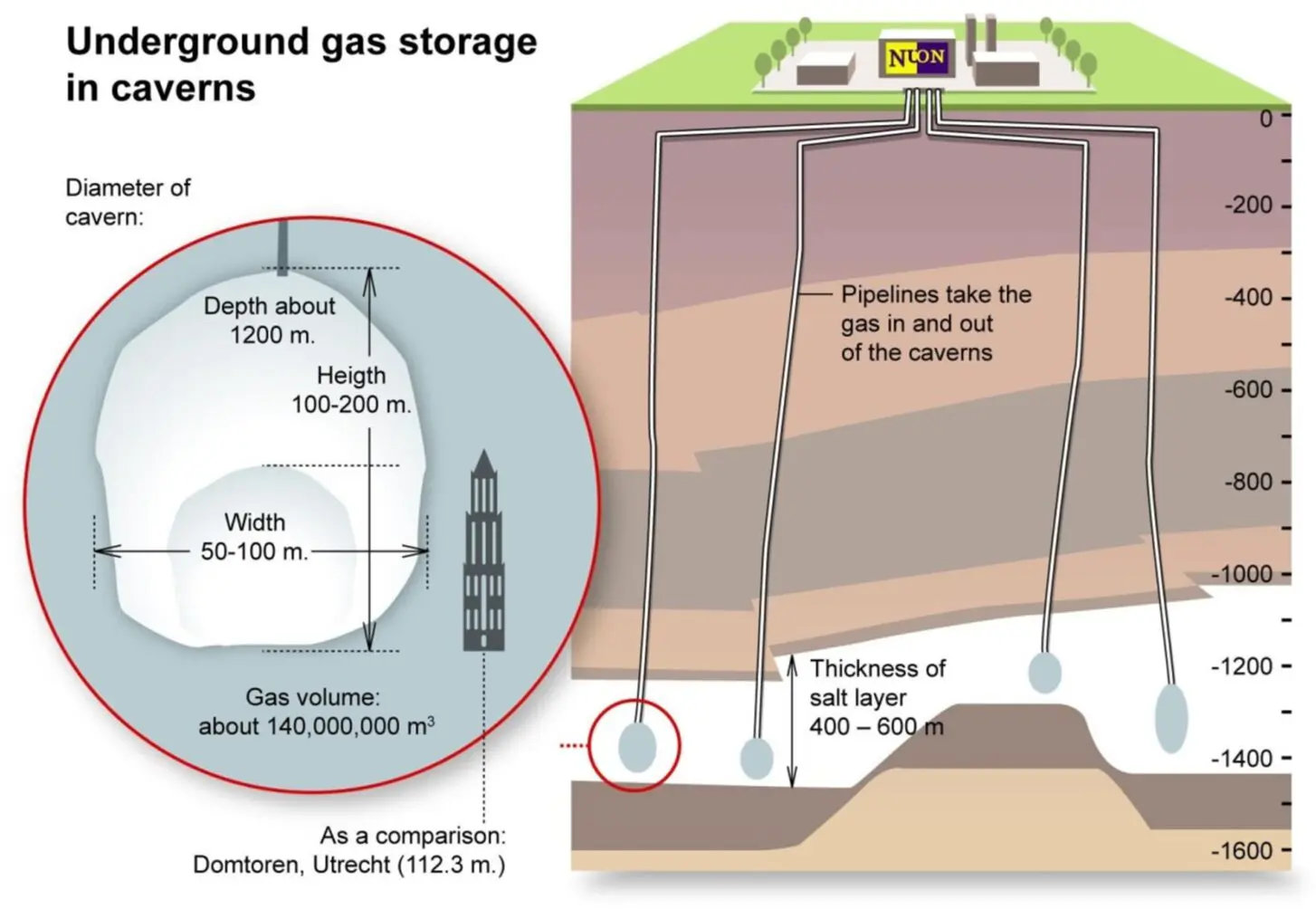
The value of a gas storage facility comes from flexibility.
On any given day, the storage operator typically has three possible choices:
- inject gas into storage;
- withdraw gas from storage; or
- take no action.
Each decision affects the opportunities available in future periods. Injecting gas today increases inventory that may be sold later. Withdrawing gas now may generate immediate revenue but reduce future flexibility.
This ability to choose between multiple operating decisions gives a storage facility embedded optionality. Unlike a simple forward contract with a predetermined delivery schedule, the owner continuously decides how the asset should be operated as market conditions evolve.
It is this operational flexibility that creates much of a storage facility’s economic value.
Where Does Gas Storage Value Come From?
Much of the value of gas storage arises from differences in prices across time.
Gas prices often vary seasonally, with lower prices during periods of weaker demand and higher prices during periods of stronger demand. Storage allows market participants to purchase gas when prices are relatively low, store it, and sell it later if market conditions become more favourable.
This is often described as capturing calendar spreads – the price differences between delivery periods.
However, storage value is not determined simply by identifying the largest spread on today’s forward curve.
Because prices evolve continuously, the operator’s decisions also evolve. The ability to respond to changing market conditions throughout the life of the asset often creates additional value beyond what is visible from today’s forward prices alone.
This is one of the reasons gas storage is more commonly viewed as an option rather than a simple buy-and-sell opportunity.
Physical Constraints Shape Every Decision
Although market prices create opportunities, every storage facility operates within physical limits. These commonly include:
- maximum storage capacity;
- minimum operating inventory (cushion);
- maximum daily injection rates;
- maximum daily withdrawal rates;
- injection and withdrawal costs;
- fuel losses; and
- operating constraints that vary with inventory levels (often called ratchets).
These constraints determine not only how much value can be extracted from the asset, but also when injection or withdrawal becomes optimal. The best commercial decision may not always be physically achievable, and the value of preserving future flexibility depends on the storage level and the facility’s remaining capacity and operating rates.
For example, even if winter prices increase sharply, the storage operator may be unable to fully exploit the opportunity if withdrawal rates are limited. Likewise, buying additional gas may not be possible if the facility is already close to full.
Accurately representing these operational constraints is therefore essential when valuing storage assets.
Valuation Is Really an Optimisation Problem
Unlike many financial instruments, the value of a gas storage facility cannot be calculated by simply applying a pricing formula.
Instead, valuation requires identifying the sequence of operating decisions that maximises value over the life of the asset.
Each day, the optimal decision depends not only on current price but on the current inventory level, the physical capabilities of the facility, and expectations about future market behaviour. As any of these variables change, the optimal operating decision may also change.
The valuation process therefore becomes an optimisation exercise that balances today’s opportunities against the flexibility that may be (more) valuable in the future.
From Valuation to an Optimal Decision Surface
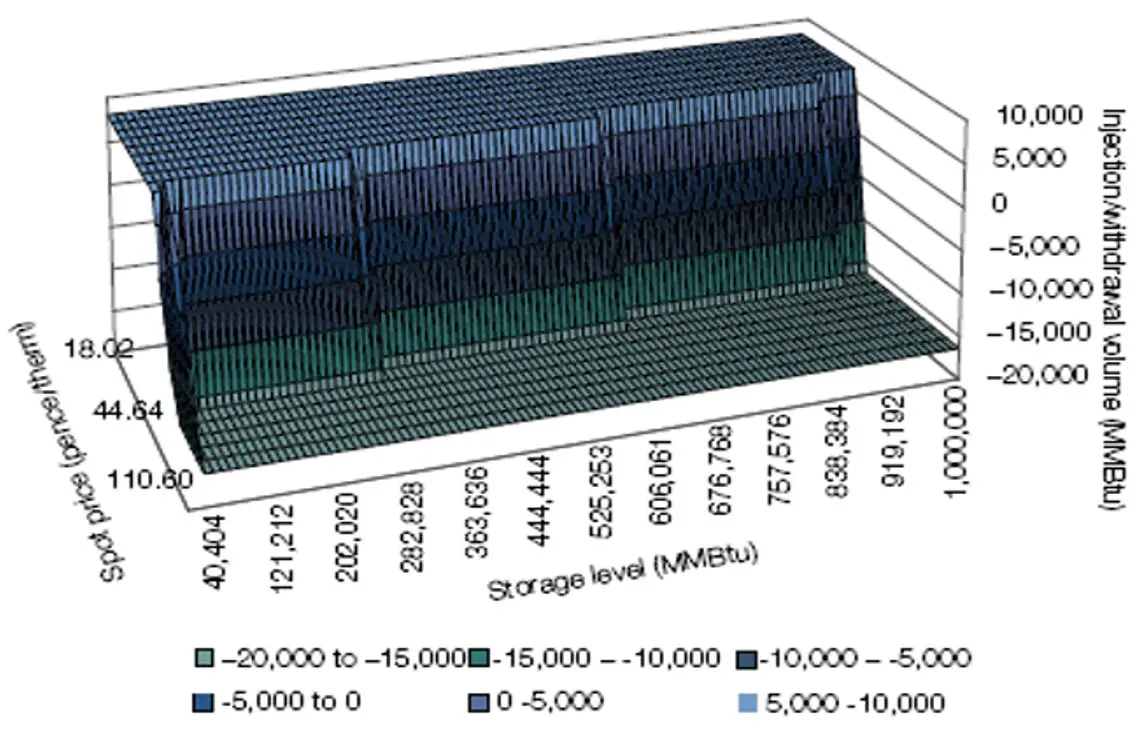
As a part of the stochastic storage valuation process, an optimised decision surface for injection and withdrawal of gas is also obtained. At each point in time, the decision surface can be used determine the optimal decision for different combinations of gas price and inventory level.
For example, lower gas prices may favour injection, while higher prices may favour withdrawal. The precise transition depends on the amount of gas already in storage, the remaining time, and the physical constraints of the facility.
This provides a practical link between valuation and operation: the model identifies how the storage facility should be operated under different market conditions and uses that to information to derive it’s worth.
Common Approaches to Gas Storage Valuation
Different analytical techniques are used depending on the purpose of the valuation and the complexity of the asset. These approaches can be viewed as progressively capturing more of the storage facility’s embedded optionality, from simple deterministic methods through to fully stochastic optimisation.
Intrinsic Valuation
Assumes today’s forward curve remains unchanged throughout the life of the storage facility.
An optimisation is performed using the current forward prices to determine the economically optimal schedule of injections and withdrawals. The result is often described as the intrinsic value of the storage facility.
This approach is:
- relatively simple;
- fast to calculate;
- transparent; and
- widely used for benchmarking.
However, it assumes future market opportunities never change.
Rolling Intrinsic Valuation
Recognises that forward curves change through time.
Rather than committing to a single operating strategy, the storage is periodically re-optimised as market prices change.
This enables operators to adjust their positions over time and potentially capture additional value as seasonal spreads strengthen or weaken.
Rolling intrinsic therefore reflects a more realistic operating strategy than static intrinsic valuation, although it still does not fully capture all the value created future market uncertainty.
Both intrinsic and rolling intrinsic are deterministic, or ‘myopic’, strategies in terms of optimisation approach: they optimise using the information available at the time rather than accounting for the uncertainty of future price movements to find today’s optimal decision.
Basket of Spread Options
Another way to view gas storage is as a portfolio of spread options.
Rather than focusing solely on today’s forward curve, this approach recognises that storage provides the opportunity to benefit from future changes in price relationships between different delivery periods.
Viewing storage in this way captures more of the embedded optionality than intrinsic methods and provides additional insight into the commercial flexibility of the asset.
The approach can therefore be viewed as adding some optionality to the calendar spreads identified by the intrinsic optimisation. It captures some of the value created when those spreads move favourably as market conditions change.
Stochastic Optimisation
Stochastic optimisation extends storage valuation by explicitly recognising that future gas prices are uncertain.
Rather than assuming a single future price path, stochastic models evaluate many possible market outcomes and determine the operating strategy that maximises value under uncertainty.
This allows the model to recognise the value of operational flexibility. For example, choosing not to inject or withdraw gas today may preserve the ability to make a more valuable decision later as market conditions evolve.
Because storage decisions depend on prices that have not yet occurred, stochastic optimisation works backwards from the end of the storage horizon to determine the optimal decision at every possible future state.
The challenge then becomes how to solve this optimisation problem.
One widely used approach are Trinomial Trees
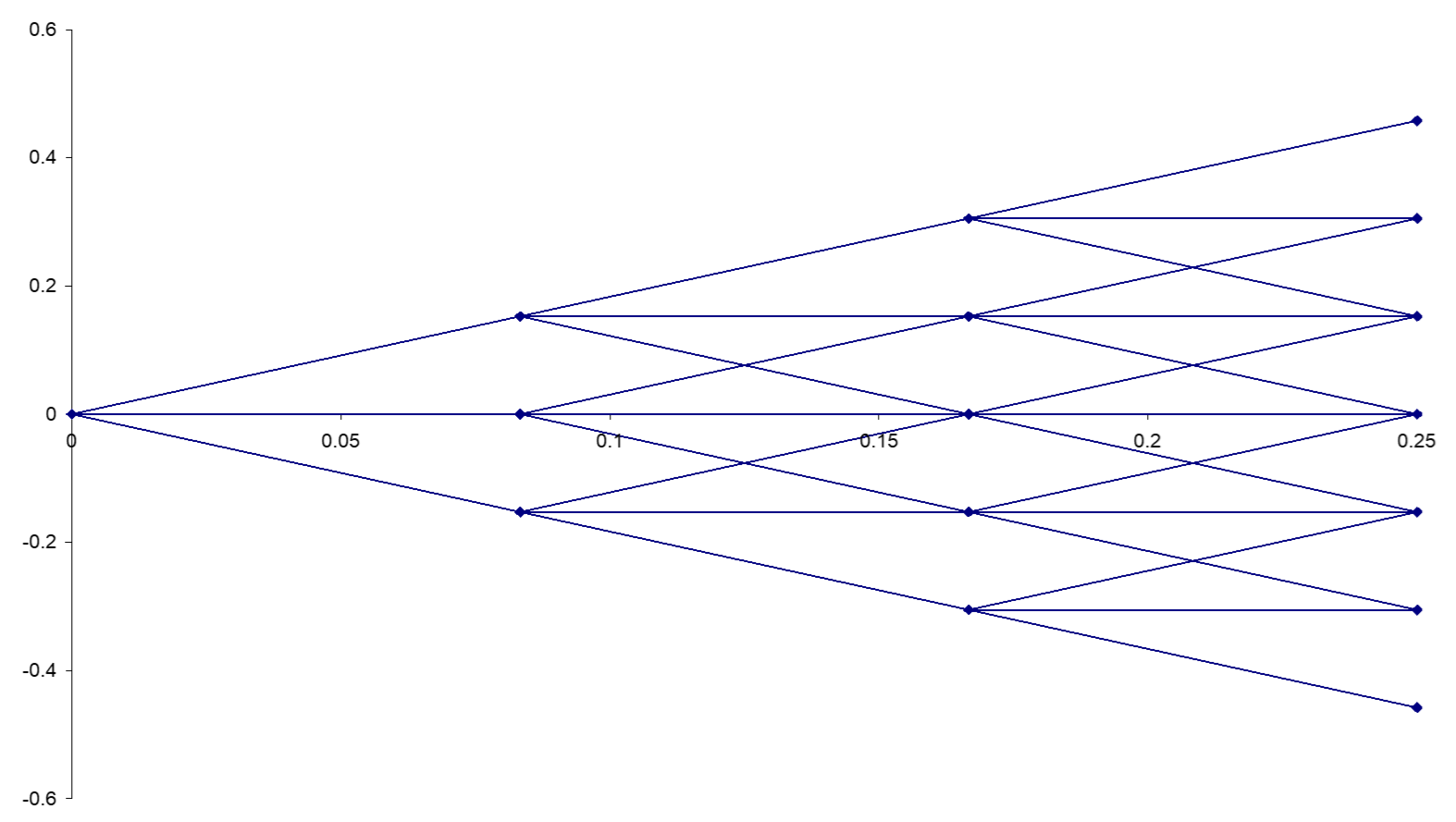
Rather than modelling a single future price path, a trinomial tree represents many possible future price movements. At each time step, prices can move up, remain unchanged, or move down, creating a branching network of possible future market states.
Working backwards through the tree, the valuation algorithm determines the optimal operational decision at every node by comparing alternatives such as:
- injecting gas;
- withdrawing gas; or
- waiting.
This process, commonly known as backward induction, ensures each decision reflects both its immediate cashflow and the value of preserving future operating flexibility.
Because every decision point is evaluated, trinomial trees provide an intuitive and computationally efficient framework for valuing storage flexibility.

Common Pitfalls and Misconceptions
Storage Value Comes Only from Seasonal Price Spreads
Seasonal spreads are important, but they are only part of the picture. Much of a storage facility’s value comes from the flexibility to respond as market conditions change over time.
The Best Strategy Is Always to Keep the Storage Full
Not necessarily. Depending on prices, future opportunities, and operational constraints, the optimal decision may be to inject, withdraw, or wait.
The highest inventory level does not always produce the highest asset value.
Today’s Decision Depends Only on Today’s Price
Current market prices are only one input.
The optimal operating decision also depends on the current inventory level, the physical capabilities of the facility, and expectations about future market behaviour.
How Gas Storage Valuation Is Addressed in Practice
Valuing gas storage requires more than forecasting prices. Organisations must combine forward curves, stochastic price models, optimisation techniques, and detailed representations of asset constraints into a consistent analytical framework.
As storage portfolios grow, maintaining these models efficiently and consistently becomes increasingly challenging. Market data, calibration assumptions, operating constraints, and optimisation methodologies all require appropriate governance and regular maintenance.
In practice, the valuation is often only the starting point: participants may also need to understand the optimal operating strategy, resulting cashflows, hedge requirements and the key drivers of value and risk.
Many organisations therefore use integrated analytics platforms to support storage valuation, optimisation, and risk analysis. Applications such as Lacima Analytics help practitioners build robust valuation models while maintaining the transparency, consistency, and auditability expected across trading, risk, finance, and commercial functions.
One-Sentence Takeaway
Gas storage derives its value from operational flexibility (the ability to make optimal injection and withdrawal decisions over time) and modern valuation techniques combine forward curves, stochastic simulation, and optimisation to quantify that flexibility.
Related Learning Resources
Learn how stochastic models represent uncertain future market behaviour and provide the foundation for advanced gas storage valuation.
What is Monte Carlo simulation?
Explore how thousands of simulated price paths are used to value assets with embedded optionality such as gas storage.
What is a Trinomial Tree Model?
Discover how lattice-based models evaluate optimal decisions at every future state when valuing assets with operational flexibility.
Understand how intrinsic valuation uses today’s forward curve to determine the optimal operating strategy for a storage asset under current market conditions.