
 Search
Learning | Quantitative Modelling Concepts
What is a Multi-Factor Model?
Introductory Summary
Many energy markets are influenced by more than one source of uncertainty.
Electricity prices may respond to both short-term weather events and longer-term fuel costs. Gas prices may exhibit temporary market shocks while also reverting towards longer-term equilibrium levels. Different delivery periods on a forward curve may move together, but not by exactly the same amount.
A single-factor model represents all price movements using one underlying stochastic process. A multi-factor model extends this framework by combining several stochastic factors, each representing a different aspect of market behaviour.
In many situations, a single-factor model provides an appropriate balance between realism and simplicity. However, in markets exhibiting behaviours that cannot be adequately represented by a single-factor alone, a multi-factor model is often a preferable choice.
Definition
A multi-factor model is a stochastic price model in which two or more underlying factors jointly determine how prices evolve through time.
Each factor represents a different source of market behaviour.
For example, one factor might represent long-term price movements while another captures shorter-term fluctuations. Alternatively, separate factors may represent different commodities, regions, or market drivers that influence the asset being valued.
By combining these effects, multi-factor models can represent a broader range of market behaviour than single-factor models.
Why Introduce More Than One Factor?
The decision to use a multi-factor model is usually driven by the behaviour of the market being modelled rather than a desire to build a more sophisticated mathematical model.
A single-factor model assumes one stochastic process is sufficient to explain future price movements. In many practical applications, however, this assumption may be too restrictive. For example, energy markets often exhibit several distinct characteristics simultaneously. Prices may demonstrate long-term mean reversion while also experiencing shorter-term fluctuations, seasonal effects, or temporary market shocks.
Representing these behaviours separately can produce simulations that better reflect observed market dynamics.
Common Examples of Multiple Factors
Different factors can represent different characteristics of market behaviour. Examples include:
- a long-term equilibrium factor combined with a short-term deviation factor;
- different commodities, such as gas and electricity, modelled simultaneously;
- separate market variables such as commodity prices, exchange rates, and carbon prices;
- multiple regional markets whose prices evolve together but not identically; or
- separate factors representing different delivery periods along the forward curve.
The choice of factors depends on the analytical problem being solved and the characteristics of the market being modelled.
Multi-Factor Models Capture Richer Market Behaviour
Each additional factor allows the model to represent another dimension of market behaviour.
For example, one factor may evolve relatively slowly, reflecting broader market trends, while another responds more rapidly to short-term market events.
Together, these factors can reproduce market characteristics that would be difficult to represent using a single stochastic process alone.
This additional flexibility is one reason multi-factor models are widely used in energy valuation, portfolio simulation, and enterprise risk analysis.
Single-Factor Versus Multi-Factor Models
Single-factor and multi-factor models should not be viewed as competing alternatives where one is always superior. Rather, they represent different levels of model complexity.
Single-factor models are often appropriate when one source of uncertainty provides a sufficiently realistic representation of market behaviour. Multi-factor models become valuable when multiple independent sources of uncertainty materially influence valuation or risk.
The appropriate choice depends on the complexity of the problem being solved, the available market data, and the objectives of the analysis.
Common Pitfalls and Misconceptions
More Factors Always Produce Better Models
Not necessarily. Multi-factor models can provide a more realistic representation of market behaviour when multiple sources of uncertainty materially influence the asset being analysed. However, they also require additional calibration, market data, and model assumptions.
If those additional factors are not relevant to the problem being solved, a simpler single-factor model may produce equally appropriate results while being easier to calibrate, interpret, and maintain.
Multi-Factor Models Predict Prices More Accurately
No. Like all stochastic models, multi-factor models generate possible future price scenarios rather than attempting to forecast exactly what will happen.
Their purpose is to represent uncertainty more realistically, not eliminate it.
How Multi-Factor Models Are Applied in Practice
The primary challenge with multi-factor modelling is not simply introducing additional stochastic factors. It is ensuring those factors interact in a realistic and internally consistent way.
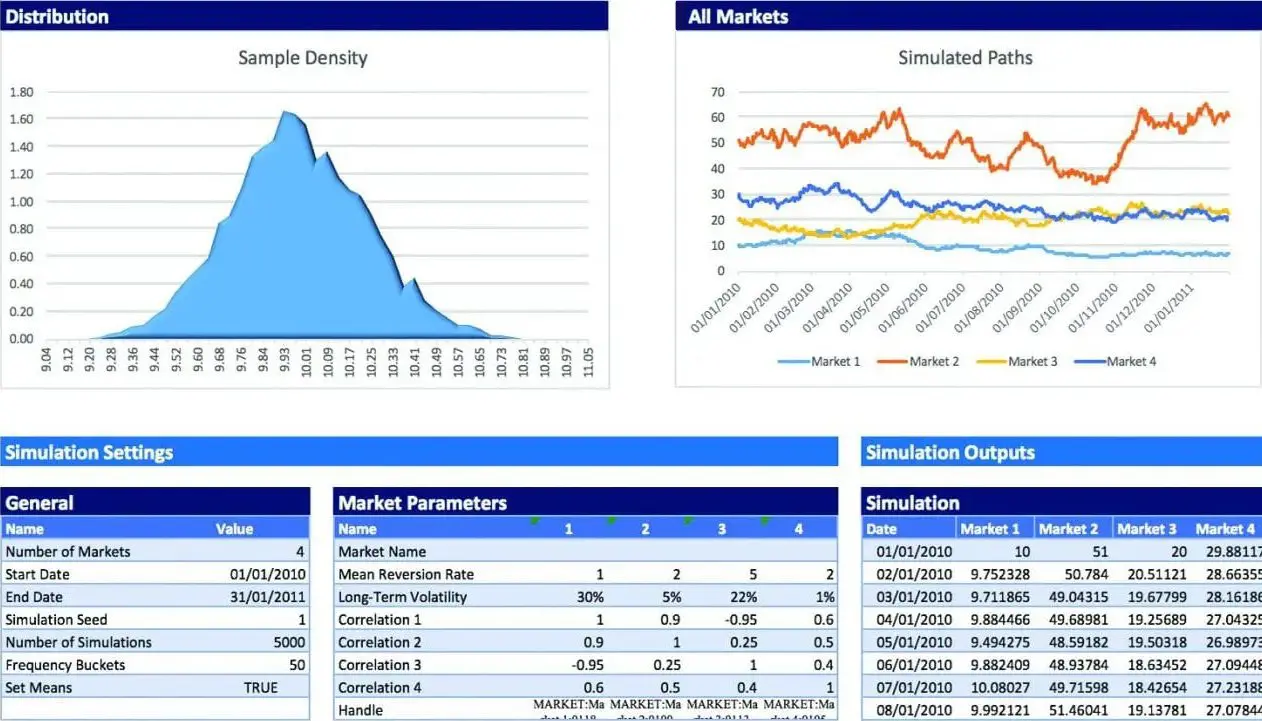
For example, a valuation model may need to represent multiple commodities, delivery periods, regions, or market drivers simultaneously, while also incorporating forward curves, volatility, correlation, and mean reversion. Each of these components influences the behaviour of the others.
Rather than treating these as separate analytical exercises, many organisations adopt a common market model that allows the same underlying assumptions to be used consistently across simulation, valuation, optimisation, and risk analysis.
Integrated analytics applications such as Lacima Analytics help practitioners manage this complexity by providing a single modelling environment in which multiple stochastic factors, market data, and valuation methodologies can be developed, governed, and applied consistently across the enterprise.
One-Sentence Takeaway
Multi-factor models represent several independent sources of market behaviour within a single stochastic framework, enabling more realistic valuation and risk analysis when a single-factor is insufficient to describe how markets evolve.
Related Learning Resources
What is a Single-Factor Model?
Learn how a single stochastic process can represent market behaviour and when this simpler modelling approach is appropriate.
Discover why relationships between multiple market variables matter when modelling complex portfolios.
Explore how stochastic models generate realistic future market scenarios for valuation and risk analysis.
What is Monte Carlo simulation?
See how multi-factor stochastic models generate thousands of possible future market scenarios for valuation and risk analysis.