
 Search
Learning | Foundations of Energy Risk
What is Stress Testing?
Introductory Summary
Stress testing is a risk analysis technique used to assess how a portfolio, business, or asset might perform under severe but plausible market conditions.
Unlike many risk measures that focus on normal market behaviour, stress testing deliberately explores extreme scenarios. In energy and commodity markets, it helps participants understand the potential impact of sharp price movements, supply disruptions, market dislocations, and other adverse events that could materially affect portfolio performance.
Definition
Stress testing evaluates the impact of a predefined adverse scenario on a portfolio or business. The objective is not to predict the future, but to answer an important question:
“What would happen if this event occurred?”
The scenario may represent:
- a historical market event
- a hypothetical market shock
- a regulatory requirement
- a participant-specific concern
The resulting analysis helps decision-makers understand where vulnerabilities may exist and whether current risk levels remain acceptable.
Why Stress Testing is Important in Energy Markets
Energy markets have a long history of events that fall well outside normal expectations. Examples include:
- sudden commodity price spikes
- extreme weather events
- infrastructure failures
- war, conflict and other geopolitical disruptions
- unexpected changes in supply and demand
While these events may be infrequent, their consequences can be significant.
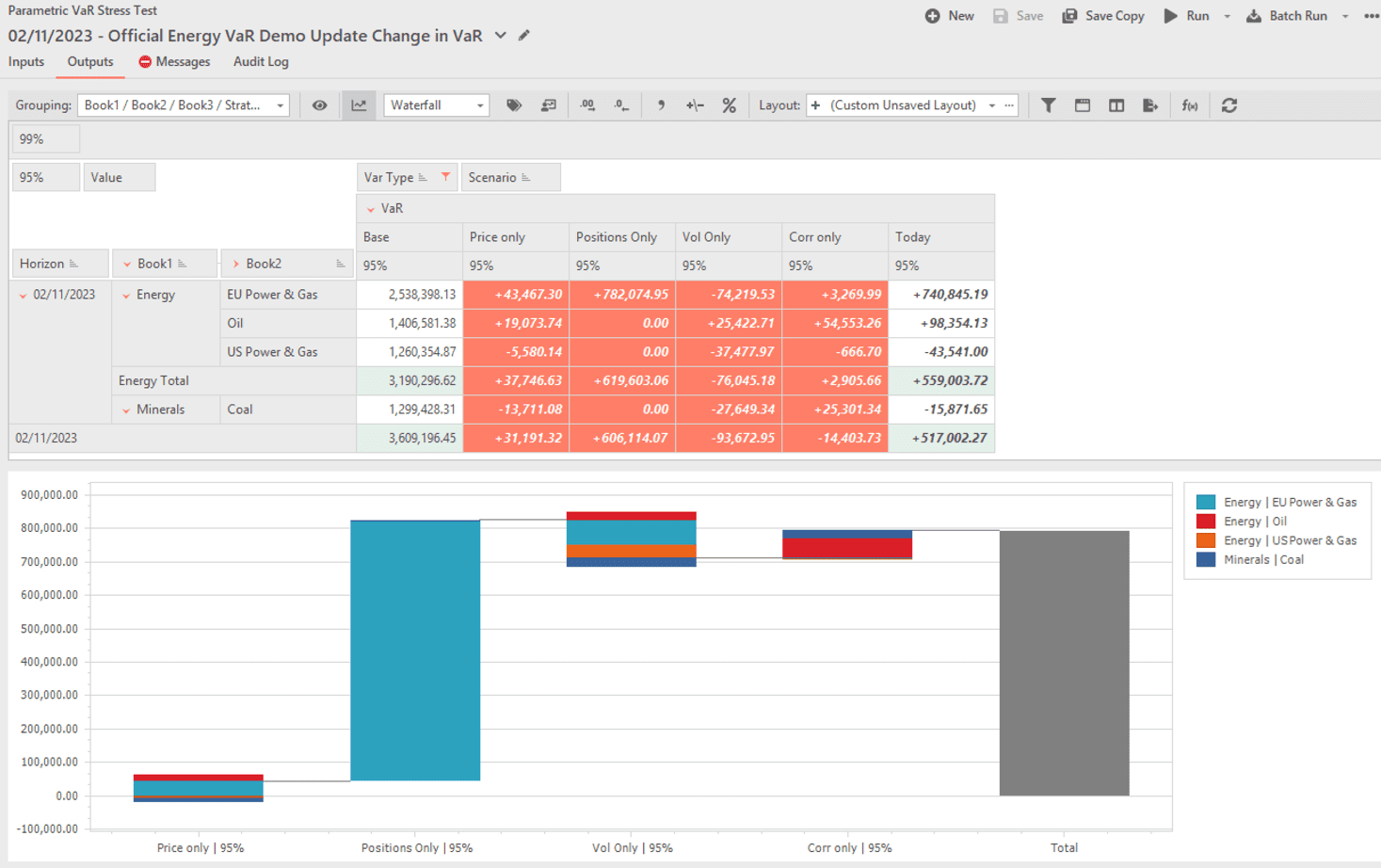
Traditional risk measures such as Value at Risk (VaR) often focus on statistically expected outcomes. Stress testing complements these approaches by examining situations that may lie beyond normal probability assumptions.
For many market participants, stress testing has become an essential part of prudent risk management and governance.
Common Types of Stress Test
Historical Stress Tests
These scenarios recreate actual market events and apply them to today’s portfolio. Examples might include:
- periods of extreme commodity price volatility
- major supply disruptions
- significant regional market dislocations
Historical stress tests help participants understand how current exposures would have behaved during past crises.
Hypothetical Stress Tests
These scenarios are designed around events that have not necessarily occurred but are considered plausible. Examples may include:
- a major LNG supply interruption
- an extended period of low renewable output
- a significant increase or decrease in gas prices
- an unexpected transmission outage
Hypothetical scenarios allow participants to explore emerging risks and future uncertainties.
Reverse Stress Tests
Rather than starting with an event, reverse stress testing starts with an outcome. For example:
“What market conditions would be required to produce a loss of this magnitude?”
This approach can reveal hidden concentrations of risk that may not be obvious through traditional analysis.
Common Pitfalls and Misconceptions
Stress Tests Predict What Will Happen
Stress tests are not predictions. They are tools for understanding the potential consequences of specific scenarios and should be interpreted as such.
Only Historical Events Are Useful Stress Test Scenarios
Past events can provide valuable insight, but future disruptions may take very different forms. A balanced stress testing framework typically incorporates both historical and forward-looking scenarios.
Portfolio Components Can Be Stress Tested Independently
Complex energy portfolios often contain relationships between:
- power
- gas
- LNG
- storage
- transportation
- generation assets
Stress scenarios that examine positions in isolation may fail to capture important portfolio effects.
How Stress Testing is Used in Practice
In practice, participants use stress testing to support:
- risk management
- portfolio reviews
- hedging decisions
- capital allocation
- investment analysis
- governance and board reporting
Many organisations maintain a library of predefined scenarios that can be applied consistently across portfolios and reporting periods.
As portfolios become larger and more complex, stress testing is increasingly integrated with valuation, simulation, and portfolio analytics processes to provide a more comprehensive view of risk.
For example, when used in conjunction with other Lacima Analytics modules, Stress Testing supports scenario-based risk analysis across energy and commodity portfolios.
One-Sentence Takeaway
Stress testing evaluates how portfolios perform under severe but plausible market scenarios, helping organisations identify vulnerabilities and assess resilience beyond normal market conditions.
Related Learning Resources
Learn how Value at Risk estimates potential portfolio losses under normal market conditions.
Explore how scenario analysis is used to evaluate the impact of changing market conditions on portfolio performance.
Understand how participants measure and aggregate exposure across energy and commodity portfolios.
What is Monte Carlo simulation?
Learn how simulation techniques are used to analyse uncertainty and complex market behaviour.
While reasonable care has been taken in preparing this information, we make no warranties or representations as to its completeness, currency or accuracy. To the extent permitted by law, Lacima accepts no liability for any loss, damage or outcome arising from its use or reliance. Use of this article is subject to the full Terms and Conditions of this website.