
 Search
Learning | Valuation Pricing Analytics
How to Value Swing Contracts
Introductory Summary
Swing contracts allow energy deliveries to vary within agreed contractual limits over the life of an agreement. If you’re unfamiliar with how these contracts work, see What is a Swing Contract?.
Unlike a standard forward contract, valuing a swing contract is not simply a matter of comparing today’s market price with the contracted price.
Instead, the challenge is to determine how the contractual flexibility should be exercised as market conditions evolve. Every exercise decision influences the flexibility that remains available later in the contract, meaning today’s decision cannot be considered in isolation.
For this reason, swing contract valuation is fundamentally an optimisation problem. The objective is to determine the exercise strategy that maximises economic value while satisfying every contractual constraint.
Understanding these optimisation approaches is essential for organisations managing gas supply portfolios, LNG contracts, power markets, and other physically flexible energy assets.
Objective of Swing Contract Valuation
Swing contract valuation seeks to estimate the value of the embedded flexibility rather than simply the value obtained by exercising the contract according to today’s market conditions.
This involves determining how the contractual flexibility would be exercised to maximise economic value under current and possible future market conditions while respecting applicable contractual constraints.
In practice, valuation therefore becomes an optimisation problem.
Because future market conditions are uncertain, valuation considers not only today’s market information but also how future prices may influence optimal exercise decisions throughout the remaining life of the contract.
Why Swing Contracts Are Different
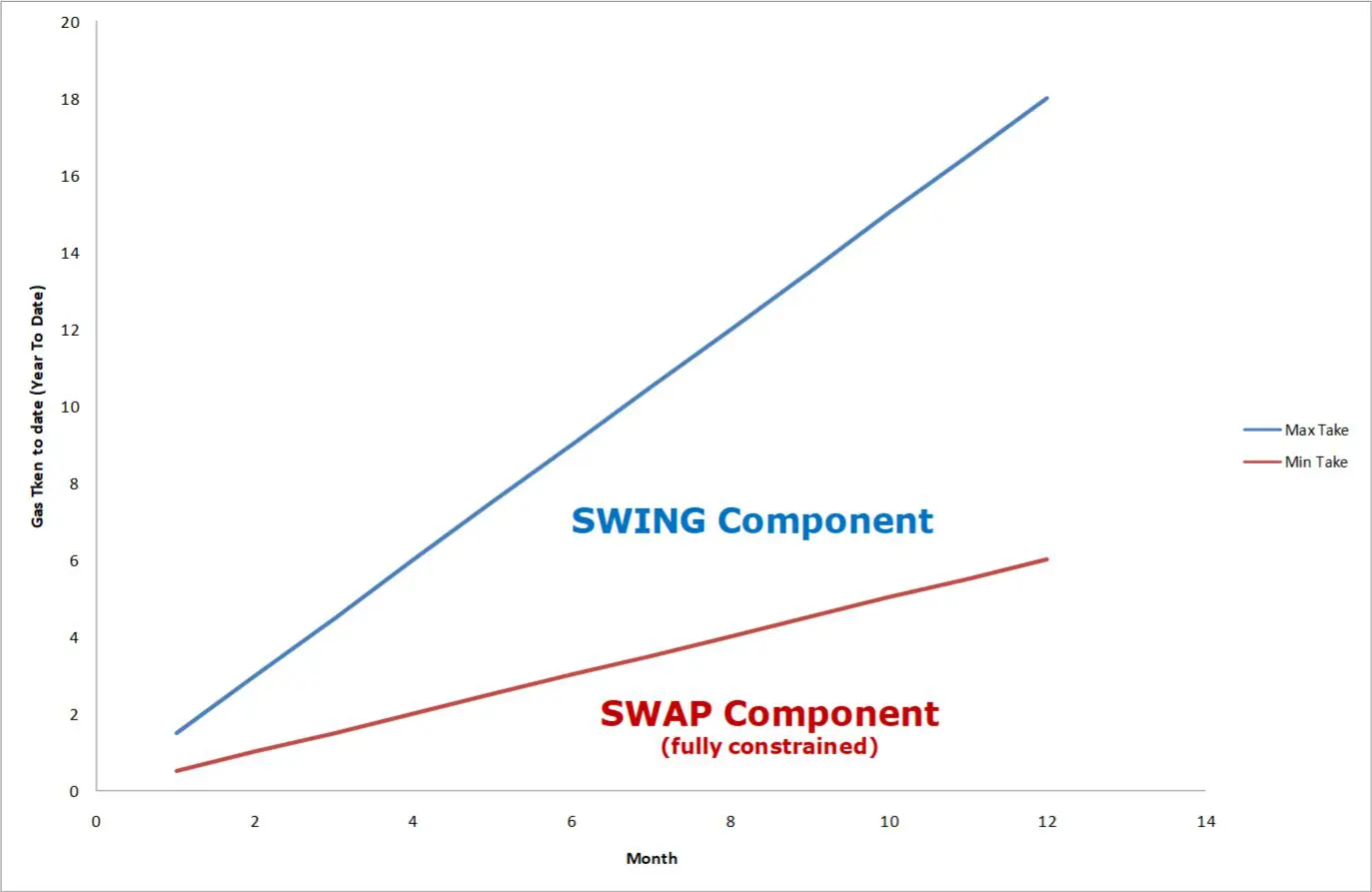
The defining feature of these contracts is the flexibility to vary deliveries within agreed contractual limits.
Typical limits include:
- minimum and maximum daily quantities;
- cumulative take obligations;
- total contract quantities;
- seasonal restrictions;
- nomination rules; and
- operational ramp-rate or delivery constraints.
Unlike a forward contract, every exercise decision changes the flexibility that remains available for future exercise. Taking additional gas today, for example, may reduce the quantities available tomorrow, while delaying deliveries may preserve flexibility for periods when market prices become more favourable.
Valuation therefore becomes a sequential optimisation problem rather than a simple pricing calculation.
The objective is to determine the exercise strategy that maximises value across the remaining life of the contract.
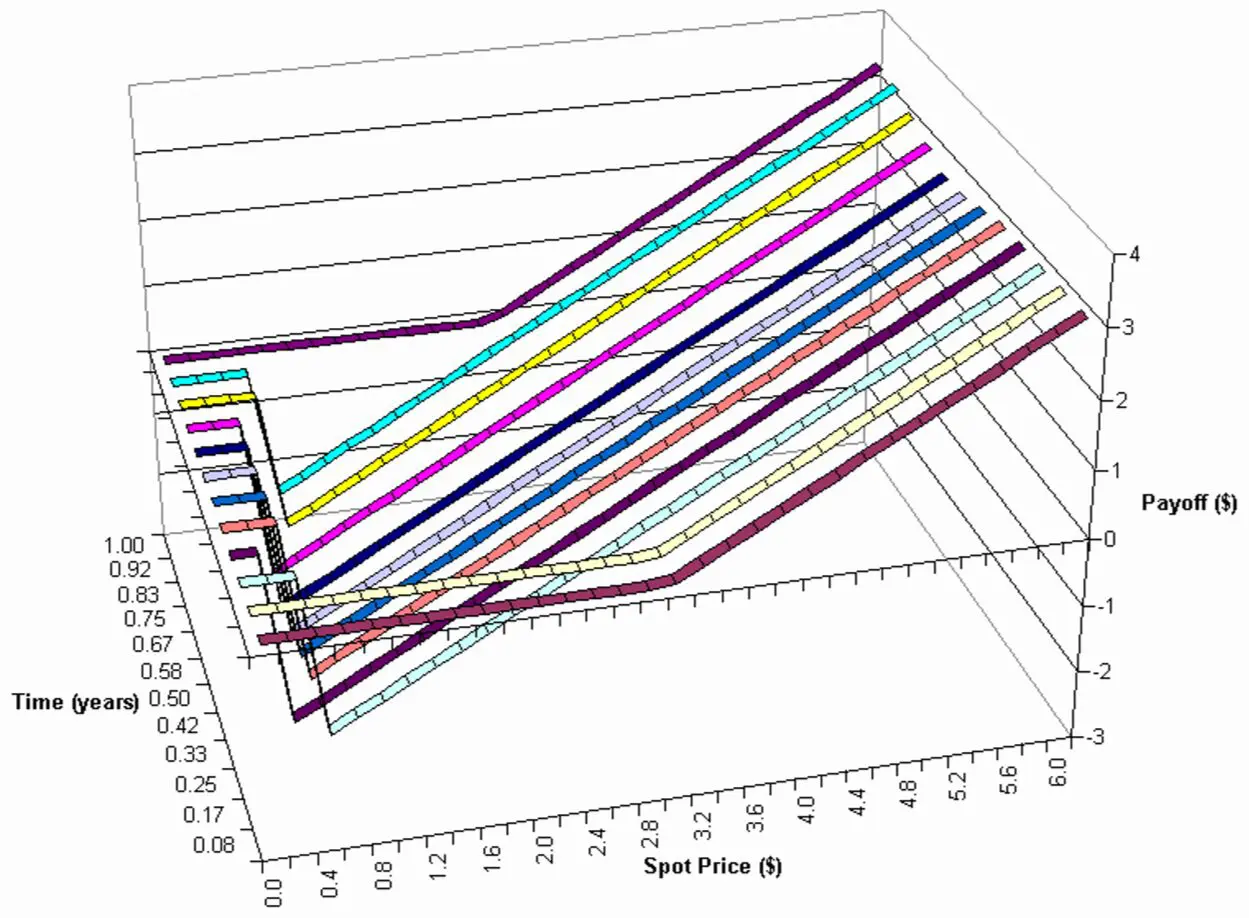
Valuation Through Optimisation
Unlike many financial instruments, a swing contract cannot be valued by pricing a predetermined series of cashflows. Instead, valuation requires determining the exercise strategy that produces the greatest economic value while satisfying every contractual constraint.
At each potential exercise opportunity, the valuation considers the current market conditions, the remaining contractual flexibility, and the future opportunities that may still arise. Rather than optimising a single decision, the valuation seeks the best sequence of decisions across the entire life of the contract.
In practice, this involves evaluating many possible future market outcomes and determining how the holder would optimally exercise the contractual flexibility at each point in time. As market conditions change, the optimisation is repeated using updated market information, continually reassessing the value of the flexibility that remains.
This optimisation-first perspective underpins modern approaches to valuing swing contracts, gas storage and many other physically flexible energy assets. The resulting optimal exercise strategy then determines the value of the contract.
The analogy with gas storage is particularly close: in both cases, the value arises from deciding how much flexibility to use today while preserving the ability to respond to future market conditions.
Common Approaches to Swing Contract Valuation
No single valuation methodology is appropriate for every swing contract or commercial objective.
Instead, practitioners typically apply progressively more sophisticated techniques depending on the degree of contractual flexibility, the importance of uncertainty, and the level of accuracy required.
Although the methodologies differ, they all share the same underlying objective: determine the exercise strategy that maximises the value of the contract while respecting its operational and contractual constraints.
Intrinsic Valuation
Intrinsic valuation assumes that today’s forward curve remains unchanged throughout the life of the contract.
Using current market prices, the valuation determines the exercise strategy that maximises the value of the available forward spreads while satisfying every contractual constraint. Because the optimisation is based entirely on today’s observable forward curve, intrinsic valuation produces a deterministic estimate of contract value.
Intrinsic valuation is computationally efficient, transparent, and provides an important benchmark for understanding the value of contractual flexibility.
However, it assumes future market prices evolve exactly as implied by today’s forward curve. As a result, it ignores the additional value created by future changes in market prices and therefore captures only the intrinsic component of the contract’s value.
For more information on Intrinsic Valuation, see What is Intrinsic Value?.
Rolling Intrinsic Valuation
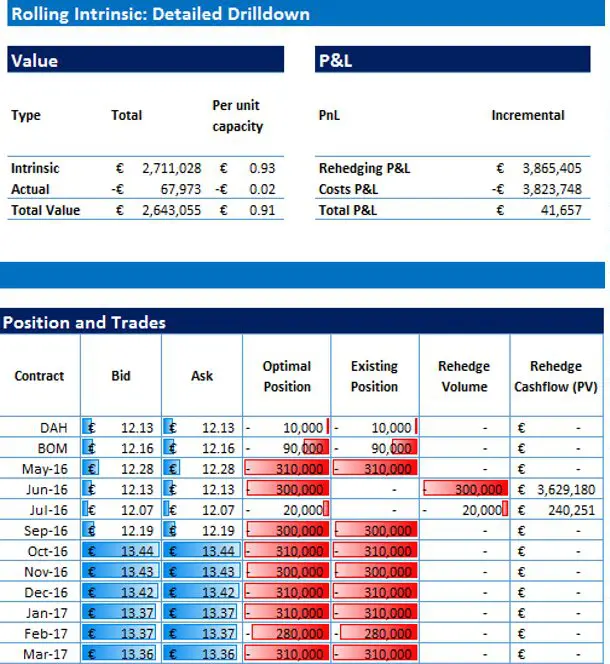
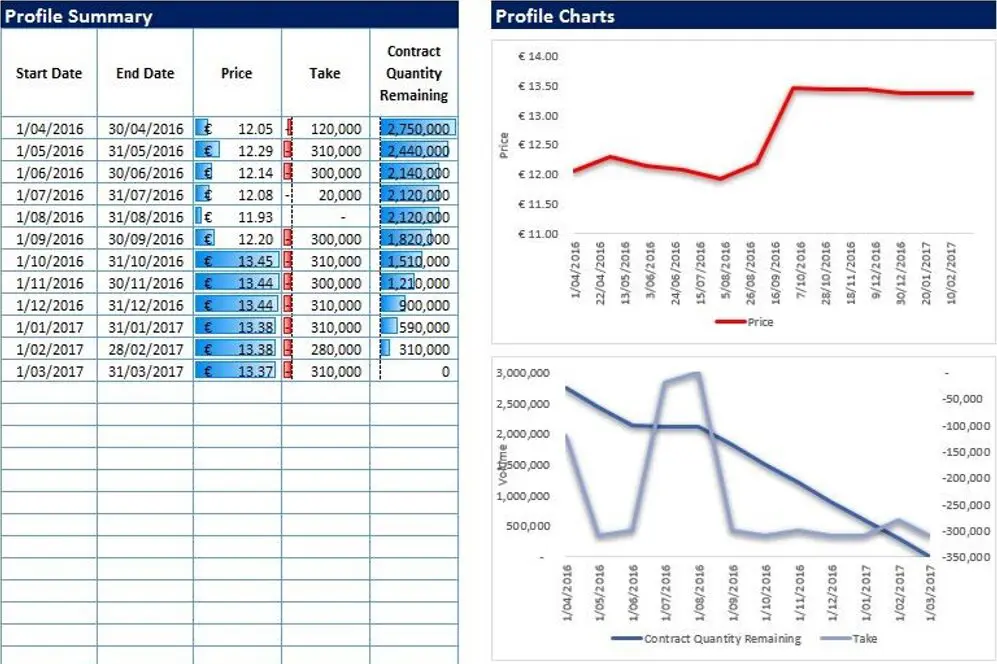
Rolling intrinsic valuation extends the intrinsic approach by recognising that exercise decisions are made repeatedly throughout the life of the contract rather than only once. As forward curves and market conditions change, the optimisation is repeated using updated market information.
Each individual optimisation remains deterministic, but repeated re-optimisation allows the exercise strategy to adapt as markets evolve.
Although rolling intrinsic does not explicitly include future price uncertainty in its optimisation. It captures part of the additional value created by changing market conditions and often provides a practical approximation where full stochastic valuation is not required.
Because of its balance between computational efficiency and improved realism, rolling intrinsic valuation is widely used for the ongoing valuation and management of physically flexible energy contracts.
Basket of Spreads
One approach to approximating swing contract optionality is to represent the contract as a basket of calendar spread options.
Rather than explicitly modelling every operational exercise decision, this approach estimates the value of flexibility through a portfolio of option-like positions on forward price spreads. These spread options capture some of the additional value created by changes in forward spreads as market conditions evolve.
Because the approach focuses on individual spread positions rather than the complete sequence of operational decisions, it generally cannot capture the full complexity of physically flexible contracts. In particular, it provides only an approximation of the interactions between multiple exercise opportunities and the operational constraints that govern how flexibility may be used over time.
Nevertheless, basket of spreads methodologies can provide useful estimates of optionality in some markets and offer a practical alternative where a full optimisation-based stochastic valuation is unnecessary.
Stochastic Valuation
Where contractual flexibility represents a significant source of commercial value, stochastic valuation is often the preferred approach.
Rather than assuming a single deterministic future, stochastic valuation explicitly represents uncertainty by modelling many possible future market outcomes.
Depending on the application, this may involve lattice-based approaches such as binomial or trinomial trees (see What is a Trinomial Tree Model?) or stochastic simulation techniques such as Monte Carlo simulation (see What is Monte Carlo Simulation?).
Simulation-based approaches use many possible future market paths and an optimisation framework to determine how contractual flexibility should be exercised without assuming that future prices are known in advance.
Because the exercise strategy can adapt to changing market conditions, stochastic valuation captures the additional value created by uncertainty itself rather than simply assuming today’s market expectations remain unchanged.
This additional value is commonly referred to as extrinsic value (see What is Extrinsic Value?), reflecting the value of retaining flexibility before future market conditions become known.
Practical Valuation Workflow
Although methodologies differ, professional swing valuation typically follows a common workflow.
Step 1: Define the Contract
The valuation begins by identifying the commercial terms of the swing agreement.
Typical inputs include:
- delivery period;
- minimum and maximum delivery quantities;
- cumulative quantity obligations;
- total contract quantities;
- contract pricing provisions;
- nomination rules; and
- operational or physical delivery constraints.
Together, these contractual terms define the flexibility available to the optimisation model and establish the constraints within which every exercise decision must be made.
Step 2: Construct the Market View
The next step is to assemble the market information required for the valuation.
This commonly includes:
- forward curves;
- historical spot prices (for model calibration where appropriate);
- volatility assumptions for stochastic methods;
- interest rates (where applicable); and
- other market calibration inputs.
The quality of these inputs has a direct impact on valuation quality.
Step 3: Optimise the Exercise Strategy
The optimisation engine determines how the contractual flexibility should be exercised throughout the remaining life of the contract.
Rather than assuming predetermined deliveries, the model identifies the sequence of exercise decisions that maximises economic value while satisfying contractual and operational constraints.
For intrinsic valuation, this optimisation is performed using today’s forward curve. For stochastic valuation, the optimisation is evaluated across many possible future market scenarios.
As forward curves and market conditions change, the optimisation can be repeated using updated market information, continually reassessing the value of the remaining contractual flexibility.
This optimisation lies at the heart of swing contract valuation – the exercise strategy produced by the optimisation determines the contract’s economic value.
Step 4: Calculate the Contract Value
Once the optimal exercise strategy has been determined, the resulting cashflows can be calculated and discounted to produce the contract’s value.
Depending on the valuation methodology, this may represent:
- intrinsic value, based on today’s forward curve;
- rolling intrinsic value, based on repeated optimisation as market conditions evolve; or
- stochastic value, incorporating both intrinsic and extrinsic value by optimising across many possible future market scenarios.
Choosing the Appropriate Valuation Method
The most appropriate methodology depends on both the contract and the commercial question being addressed.
Intrinsic valuation may be entirely appropriate where contracts contain relatively limited flexibility or where rapid daily valuation is required.
As optionality becomes more significant, however, more sophisticated approaches may be justified.
Stochastic valuation generally provides a more complete representation of flexibility because it recognises that exercise decisions can adapt as uncertainty unfolds.
The additional computational effort is often worthwhile where optionality represents a material component of commercial value.
Common Pitfalls and Misconceptions
Swing Contracts Can Be Valued Like Forward Contracts
Forward contracts have fixed delivery obligations. Swing contracts contain operational flexibility. Treating them identically ignores the very feature that creates much of their value.
More Sophisticated Models Always Produce Better Results
Model sophistication should match the commercial problem. A highly complex stochastic model is not automatically superior if contract optionality is limited or if market assumptions cannot be supported.
Optimisation Is Separate from Valuation
For swing contracts, optimisation and valuation are closely linked. Determining the optimal exercise strategy is fundamental to determining the contract’s economic value.
Managing Swing Contract Valuation in Practice
As organisations manage increasing numbers of physically flexible contracts across multiple commodities and regions, maintaining consistent valuation methodologies becomes progressively more challenging.
Valuation models must incorporate changing forward curves, contractual constraints, optimisation algorithms, and, where appropriate, stochastic price simulations, while remaining transparent, repeatable, and suitable for audit and governance.
Applications such as Lacima Trader enable traders, analysts, and quantitative teams to perform sophisticated swing contract valuation, optimisation, and scenario analysis efficiently within Microsoft Excel using their existing market data and forward curves.
For organisations requiring enterprise-scale capabilities, Lacima Analytics extends these analytical workflows through integrated market data management, optimisation, portfolio valuation, governance, workflow automation, and reporting across complex energy and commodity portfolios.
One-Sentence Takeaway
Swing contract valuation is fundamentally an optimisation problem that determines how contractual flexibility should be exercised under market uncertainty, making it one of the most sophisticated forms of valuation in energy and commodity markets.
Related Learning Resources
Understand how swing contracts create operational flexibility and why they are widely used in gas and power markets.
Learn how intrinsic valuation estimates the value of flexible contracts using today’s observable forward curve.
Discover how market uncertainty creates additional value beyond intrinsic valuation.
Explore how optimisation, simulation and optionality are applied to one of the most sophisticated flexible assets in energy markets.