
 Search
Learning | Energy & Commodity Derivatives
What is an Energy Option?
Introductory Summary
Many commercial decisions in energy markets involve uncertainty.
A generator may wish to benefit if power prices rise while limiting downside risk if prices fall. A gas buyer may want protection against price spikes without committing to purchase gas at a fixed price. An LNG portfolio manager may wish to retain flexibility over future delivery decisions.
Energy options were developed to address challenges like these.
Unlike forward or futures contracts, which create obligations for both parties, options provide a right but not an obligation. This flexibility can have significant value, particularly in energy markets where prices are volatile and operational decisions often need to adapt to changing conditions.
Definition
An energy option is a contract that gives its holder the right, but not the obligation, to buy or sell an underlying commodity at a specified price during a defined period or on a specified date.
The buyer of the option pays a premium to obtain this right.
The seller of the option receives the premium and assumes the obligation to perform if the buyer chooses to exercise the option.
Why Optionality Has Value
At its simplest, an option provides choice. The holder can decide whether exercising the option is beneficial based on market conditions at the time.
If market conditions move favourably, the option may be exercised. If they do not, the holder can simply allow the option to expire.
This asymmetrical payoff structure is what gives options their value.
In energy markets, where prices can move significantly due to weather events, supply disruptions, infrastructure constraints, or changes in demand, the ability to respond to evolving market conditions can be extremely valuable.
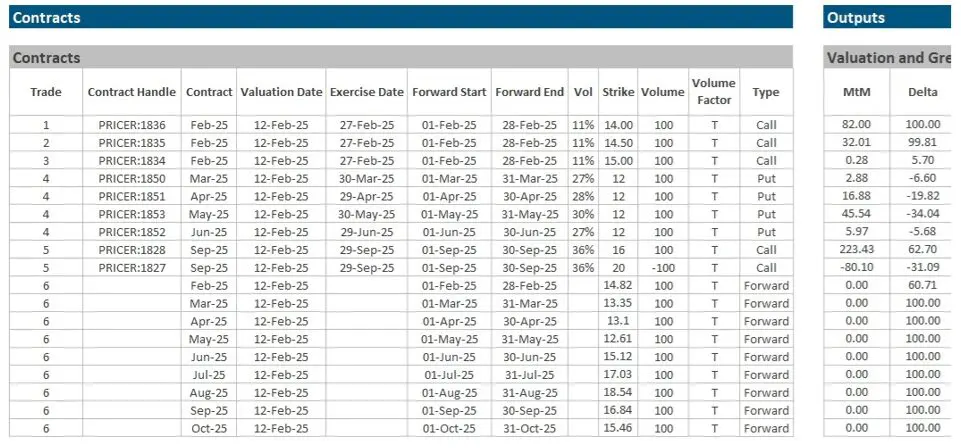
Call Options and Put Options
Most option contracts fall into one of two categories:
| Call Options | Put Options |
|---|---|
| A call option provides the right to buy the underlying commodity at a specified price. | A put option provides the right to sell the underlying commodity at a specified price. |
| Participants may purchase call options when they wish to cap their exposure to rising prices while retaining the ability to buy at lower market prices if prices fall. | Participants may purchase put options when they wish to protect against falling prices while maintaining exposure to potential price increases. |
Together, call and put options form the foundation of many energy risk management and trading strategies.
Options Beyond Financial Markets
When people first encounter options, they often think of exchange-traded financial instruments. In energy markets, however, optionality appears in many forms, such as:
- LNG destination flexibility;
- power generation assets; and
- transportation agreements.
In each case, value is derived from the ability to make future decisions in response to changing market conditions.
This concept of embedded optionality is a recurring theme in energy valuation and risk management.
Why Options Are Important in Energy Markets
Many energy assets and contracts cannot be adequately understood using fixed-price assumptions alone.
The value of a gas storage facility, for example, depends largely on the ability to decide when to inject or withdraw gas. Similarly, the value of flexible LNG contracts often depends on decisions that may be made months or years after the contract is signed.
Options provide a framework for valuing this flexibility.
As a result, option theory plays an important role across energy trading, asset valuation, portfolio optimisation, and risk management.
Common Misunderstandings
Buying an Option Creates an Obligation to Exercise It
Unlike forwards and futures contracts, option holders are not required to exercise their rights. They exercise only when it is economically beneficial to do so.
Optionality Only Exists in Financial Contracts
Many participants underestimate the extent to which optionality exists within physical energy assets and commercial agreements. In practice, some of the most valuable options in energy markets are embedded within physical infrastructure and operational decisions.
Energy Options Always Involve Physical Delivery
A common misconception is that the seller of an energy option must own or produce the underlying commodity.
In practice, energy options may be physically or financially settled depending on the contract structure. Option sellers can include producers, utilities, traders, financial institutions, and other market participants.
What matters is that the option buyer acquires a right, while the seller assumes an obligation if that right is exercised.
There’s no Extra Charge for this Flexibility
The ability to make decisions in the future has value. Whether through an explicit premium or through contract design, participants typically pay for flexibility in some form.
In a vanilla energy option, this is reflected directly in the structure of the contract: the buyer pays a premium, while the seller receives that premium in exchange for taking on the associated optionality risk.
Energy Options in Practice
Energy options are used for a wide range of purposes, including:
- hedging price exposure;
- protecting revenues;
- managing procurement costs;
- valuing physical assets; and
- supporting portfolio optimisation.
As portfolios become more sophisticated, participants often need to evaluate thousands of potential future market outcomes when assessing the value of optionality.
This is one reason advanced valuation techniques such as Monte Carlo simulation, and stochastic optimisation have become increasingly important in modern energy analytics. Tools like Lacima Trader can help participants apply these techniques efficiently and accurately.
One-Sentence Takeaway
Energy options provide valuable flexibility by giving participants the right, but not the obligation, to respond to future market conditions as they unfold.
Related Learning Resources
Learn how forward contracts differ from options by creating obligations rather than rights.
Explore one of the most important forms of optionality found in energy and gas markets.
Understand how intrinsic value represents the immediate exercise value of an option.
Learn how uncertainty and future flexibility contribute additional value beyond immediate exercise value.