
 Search
Learning | Foundations of Energy Risk
What is Earnings at Risk (EaR)?
Introductory Summary
Most organisations plan around earnings targets.
Budgets, investment decisions, business plans, and performance objectives all depend on assumptions about future profitability. Earnings at Risk (EaR) provides a framework for understanding how sensitive those earnings may be to changing market conditions.
In energy and commodity markets, where revenues and costs are often directly linked to volatile commodity prices, EaR helps participants assess the potential impact of uncertainty on future financial performance. It is commonly used to support budgeting, hedging decisions, performance forecasting, and risk management activities.
Definition
Earnings at Risk (EaR) measures the potential reduction in expected earnings over a specified period resulting from adverse market movements.
The objective is not simply to estimate risk, but to understand how uncertainty may affect the profitability of a business, portfolio, or asset.
Looking Beyond Portfolio Value
A portfolio can experience significant fluctuations in value without necessarily affecting reported earnings in the same way.
Similarly, earnings may be affected by factors that are not immediately visible through traditional portfolio valuation metrics.
For senior management, understanding the potential variability of future earnings is often more relevant than understanding daily movements in portfolio value.
This is one reason EaR has become an important complement to measures such as VaR.
What Drives Earnings Volatility?
The factors influencing earnings vary between participants, but commonly include:
Commodity Prices
Changes in market prices can directly affect revenues, procurement costs, and asset economics.
Operational Performance
Asset availability, generation output, storage utilisation, and transportation capacity can influence earnings outcomes.
Portfolio Structure
The mix of physical assets, contracts, derivatives, and commercial arrangements can materially alter earnings sensitivity.
Market Conditions
Changes in volatility, market liquidity, and regional price relationships can all affect profitability.
How EaR Supports Planning and Budgeting
EaR is often used as a bridge between market risk analysis and financial planning.
EaR is commonly used to assess:
- earnings stability
- exposure to market volatility
- hedging effectiveness
- budget assumptions
- strategic alternatives
- investment decisions
Rather than focusing solely on expected outcomes, EaR highlights the range of profitability outcomes that may occur under different market conditions.
Limitations of Earnings Forecasting
No model can perfectly predict future earnings. Market conditions change, operational circumstances evolve, and assumptions inevitably prove imperfect.
EaR should therefore be viewed as a decision-support tool rather than a forecasting tool. Its value lies in helping participants understand uncertainty and prepare for a range of possible outcomes.
How Participants Use EaR
In practice, most participants use EaR to support:
- budgeting
- business planning
- hedging programmes
- investment decisions
- risk reporting
EaR is commonly incorporated into broader enterprise risk management and planning processes. By combining earnings analysis with valuation, simulation, stress testing, and scenario analysis, participants can gain a more comprehensive understanding of financial performance risk.
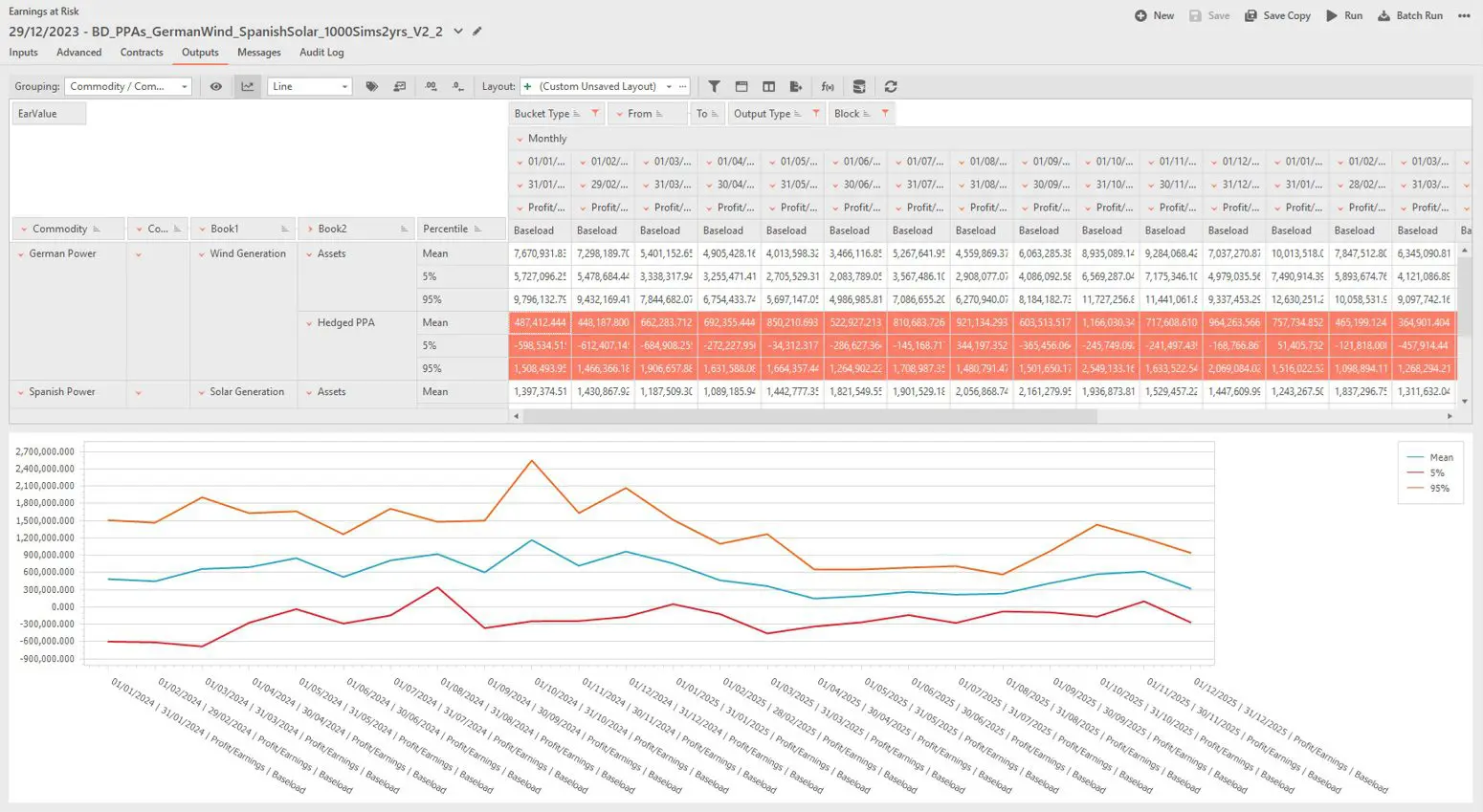
For example, Lacima Analytics Earnings at Risk supports the assessment of future earnings exposure across energy and commodity portfolios.
One-Sentence Takeaway
Earnings at Risk (EaR) estimates how adverse market conditions could reduce future earnings, helping organisations understand profitability risk and make more informed budgeting, hedging, and investment decisions.
Related Learning Resources
What is Cash Flow at Risk (CFaR)?
Learn how Cash Flow at Risk measures the potential impact of market uncertainty on future cash generation.
Explore how Value at Risk estimates potential portfolio losses under normal market conditions.
Learn how scenario analysis is used to assess the impact of changing market conditions on portfolio performance.
Understand how stress testing helps participants evaluate portfolio resilience under severe market conditions.
While reasonable care has been taken in preparing this information, we make no warranties or representations as to its completeness, currency or accuracy. To the extent permitted by law, Lacima accepts no liability for any loss, damage or outcome arising from its use or reliance. Use of this article is subject to the full Terms and Conditions of this website.