
 Search
Learning | Valuation & Pricing Analytics
What is Monte Carlo simulation?
Introductory Summary
Energy and commodity markets are shaped by uncertainty. Prices fluctuate, demand shifts, weather patterns evolve, and market conditions rarely unfold exactly as expected.
Monte Carlo simulation is a technique used to explore that uncertainty by generating many possible future market outcomes. Rather than relying on a single forecast, it produces a distribution of scenarios that participants can analyse to estimate value, understand risk, and assess how portfolios may behave under a range of conditions.
It has become one of the most important numerical methods in energy and commodity analytics, underpinning everything from derivative valuation and asset optimisation to Value at Risk (VaR) and credit exposure analysis.
Definition
Monte Carlo simulation is a numerical technique that estimates the expected value and risk of uncertain outcomes by simulating a large number of possible future scenarios.
Instead of attempting to predict exactly what will happen, Monte Carlo asks:
“If the future can unfold in many different ways, what does the range of possible outcomes look like?”
By averaging outcomes across thousands of simulated paths, participants can estimate values, probabilities, and risk measures that would otherwise be difficult, or even impossible, to calculate analytically.
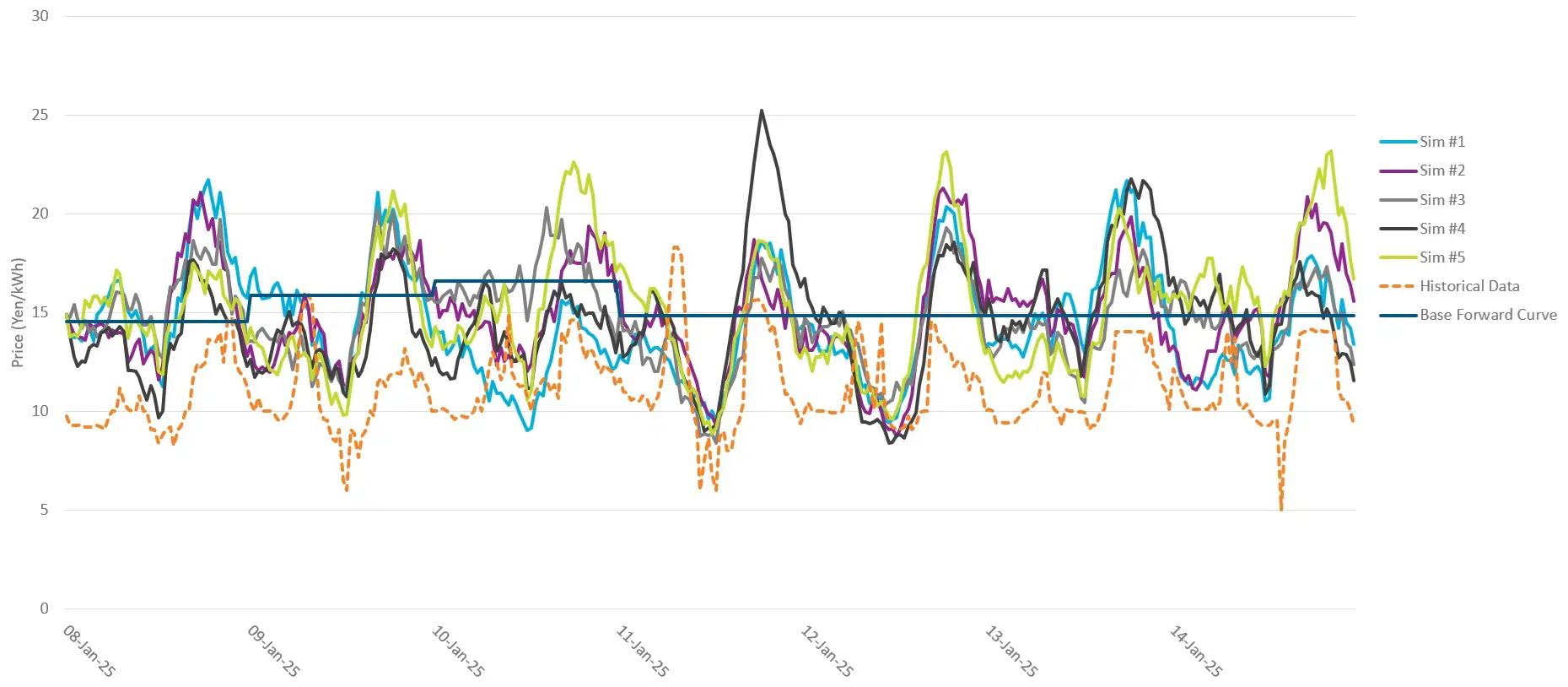
Why Monte Carlo simulation Matters in Energy Markets
Some financial instruments can be valued using closed-form equations. Energy markets are rarely that simple.
Participants often need to model:
- multiple commodities simultaneously;
- changing forward curves;
- seasonal patterns;
- operational constraints;
- complex contract structures;
- path-dependent exposures; and
- optionality embedded within physical assets.
In these situations, analytical solutions may not exist or may become impractical. Monte Carlo simulation provides a practical alternative. Rather than solving the problem directly, it estimates the answer through repeated sampling of possible future market conditions.
As a result, Monte Carlo has become one of the two principal numerical valuation approaches used in energy analytics, alongside lattice-based methods such as binomial and trinomial trees.
How Monte Carlo simulation Works
At its core, Monte Carlo simulation follows a relatively straightforward process:
Step 1. Define the Market Model
The first step is specifying how relevant market variables behave over time. Depending on the problem being analysed, this may include:
- commodity prices;
- forward curve dynamics;
- volatility assumptions;
- correlations between markets;
- mean reversion characteristics.
The objective is to capture the uncertainty that drives the problem being evaluated.
Step 2. Generate Multiple Simulation Paths
Using the chosen market model, the simulation produces a large number of possible future scenarios. Each path represents one potential evolution of market conditions. No individual path is intended to be a prediction. Instead, the collection of paths represents the range of outcomes that could occur.
Step 3. Calculate Outcomes
For each simulated path, the model calculates the relevant outcome. This could include:
- derivative payoffs;
- portfolio values;
- future cash flows;
- collateral requirements; or
- credit exposures.
Step 4. Analyse the Results
Once all simulations have been completed, the outcomes are aggregated. The average discounted payoff provides an estimate of value, while the broader distribution provides insight into uncertainty and risk.
In practice, Monte Carlo is often used to estimate expectations:
The value of a contract is frequently the discounted expected value of its future cash flows. Simulation provides a practical way of evaluating that expectation when direct analytical solutions are unavailable.
Practical Applications in Energy and Commodity Markets
Monte Carlo simulation supports a wide range of analytical activities:
Valuing Complex Derivatives
Many energy derivatives contain features that cannot easily be valued using closed-form methods. Simulation can help estimate the value of these contracts under uncertain future conditions.
Physical Asset Valuation
Participants use simulation to analyse assets such as:
- gas storage facilities;
- power generation assets;
- LNG portfolios; and
- tolling agreements.
Market Risk Analysis
Simulation techniques are frequently used when calculating:
Credit Risk Assessment
Monte Carlo approaches can support analyses of:
- Potential Future Exposure (PFE);
- counterparty exposure profiles;
- collateral requirements.
Convergence and Computational Considerations
One important characteristic of Monte Carlo simulation is that its accuracy generally improves as the number of simulations increases.
A model based on a few hundred scenarios may produce unstable estimates. As the number of paths increases into the thousands, tens of thousands, or even millions, results typically become more reliable.
This process is often referred to as convergence.
However, additional simulations require additional computational effort. Participants therefore seek an appropriate balance between accuracy and efficiency.
Improving Efficiency
Because simulation can be computationally intensive, practitioners often employ variance reduction techniques to improve accuracy without proportionally increasing the number of simulations. Examples include approaches such as antithetic sampling.
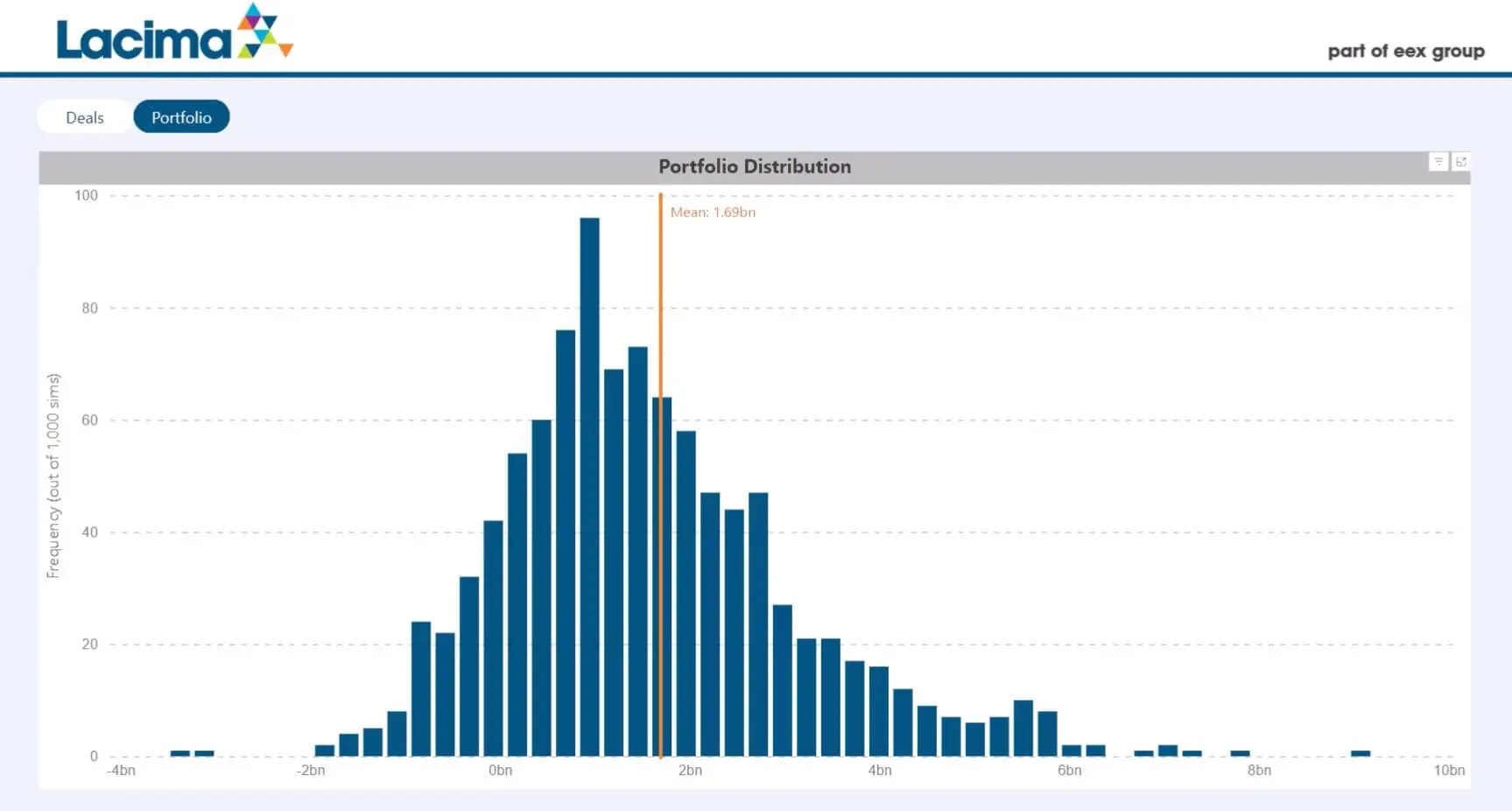
While the underlying mathematics can become highly technical, the objective remains straightforward: Achieve more stable results using available computational resources more efficiently.
Common Misconceptions
More Simulations Automatically Mean Better Models
Running additional paths can improve statistical accuracy. However, simulation quality also depends heavily on:
- model selection (and the accuracy/limitations of that model);
- calibration;
- the assumptions being used; and
- the quality of input data.
A sophisticated simulation can still produce misleading conclusions if it is built on unrealistic assumptions or an inappropriate underlying market model.
Monte Carlo simulation Predicts the Future
Monte Carlo does not forecast exactly what will happen. It explores what could happen under a specified set of assumptions.
Its value lies in understanding uncertainty rather than predicting precise outcomes.
Monte Carlo Is Only Used for Derivative Valuation
Although widely associated with option pricing, Monte Carlo has applications across valuation, optimisation, market risk, and credit risk.
Its usefulness extends well beyond financial derivatives.
Monte Carlo simulation in Professional Practice
Applying simulation techniques effectively requires more than computational capability. Participants must establish appropriate governance around:
- model selection;
- calibration methodologies;
- data quality;
- validation processes; and
- interpretation of results.
Integrated analytical environments, like those offered through Lacima Analytics, help ensure these techniques are applied consistently across portfolios containing multiple commodities, contracts, and physical assets.
As portfolios become increasingly interconnected, simulation remains one of the most practical tools available for understanding uncertainty and supporting informed decision-making.
One-Sentence Takeaway
Monte Carlo simulation enables participants to estimate value and understand risk by exploring thousands of possible futures rather than relying on a single view of what lies ahead.
Related Learning Resources
What is Monte Carlo simulation?
Compare lattice-based valuation with simulation-based approaches for modelling uncertain future market prices.
Explore how stochastic processes are used to represent uncertainty in energy markets.
Understand how simulation techniques are used to estimate portfolio risk.
Discover why selecting and calibrating market models remains critical to simulation quality.